How to Draw Plane From Ww1
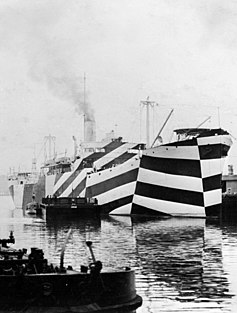
Dazzle camouflage, also known as razzle dazzle (in the U.South.) or dazzle painting, was a family unit of ship camouflage used extensively in Globe War I, and to a lesser extent in World War II and afterwards. Credited to the British marine artist Norman Wilkinson, though with a rejected prior claim by the zoologist John Graham Kerr, information technology consisted of circuitous patterns of geometric shapes in contrasting colours, interrupting and intersecting each other.
Unlike other forms of cover-up, the intention of dazzle is not to muffle but to make information technology difficult to estimate a target'due south range, speed, and heading. Norman Wilkinson explained in 1919 that he had intended dazzle primarily to mislead the enemy about a ship's class and so crusade them to have up a poor firing position.[a]
Dazzle was adopted by the Admiralty in the UK, and and then by the United States Navy. Each send'south dazzle design was unique to avoid making classes of ships instantly recognisable to the enemy. The result was that a profusion of dazzle schemes was tried, and the evidence for their success was at best mixed. So many factors were involved that it was impossible to make up one's mind which were of import, and whether any of the color schemes were effective. Experiments were carried out on shipping in both World Wars with little success.
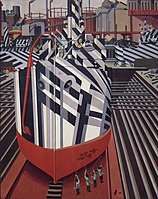
Dazzle attracted the notice of artists such equally Picasso, who claimed that Cubists like himself had invented it.[three] Edward Wadsworth, who supervised the camouflaging of over two,000 ships during the Get-go World War, painted a serial of canvases of dazzle ships [b] [4] [5] [6] [vii] after the war, based on his wartime work. Arthur Lismer similarly painted a series of dazzle ship canvases.
Intended purposes [edit]
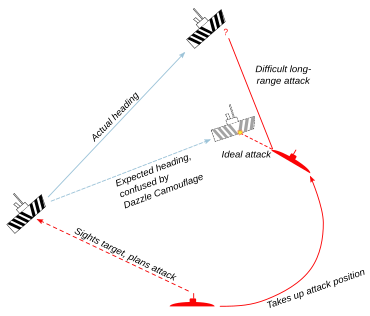
Depiction of how Norman Wilkinson intended dazzle camouflage to crusade the enemy to accept up poor firing positions[8]
At first glance, dazzle seems an unlikely grade of camouflage, drawing attention to the ship rather than hiding it. The arroyo was adult after Allied navies were unable to develop effective ways to hibernate ships in all atmospheric condition conditions. The British zoologist John Graham Kerr proposed the application of camouflage to British warships in the First World State of war, outlining what he believed to be the applicable principle, disruptive camouflage, in a letter to Winston Churchill in 1914 explaining the goal was to confuse, not to conceal, by disrupting a ship'south outline. Kerr compared the effect to that created by the patterns on a series of land animals, the giraffe, zebra and jaguar.[ix] [10]

Eyepiece prototype of a warship in a naval rangefinder, prototype halves not however adjusted for range. The target's masts are particularly useful for rangefinding, so Kerr proposed disrupting these with white bands.[ten]
Taking upwardly the zebra example, Kerr proposed that the vertical lines of ships' masts exist disrupted with irregular white bands. Hiding these would make ships less conspicuous, and would "greatly increase the difficulty of accurate range finding".[10] [c] Withal, in the same letter, Kerr also called for countershading, the utilize of paint to obliterate self-shading and thus to flatten out the appearance of solid, recognisable shapes. For example, he proposed painting ships' guns grayness on top, grading to white below, and then the guns would disappear confronting a grey background. Similarly, he advised painting shaded parts of the ship white, and brightly lit parts in grey, once more with smooth grading between them, making shapes and structures invisible. Kerr was thus hoping to accomplish both a measure of invisibility and a degree of confusion for the enemy using a rangefinder. Whether through this mixing of goals, or the Admiralty's skepticism about "any theory based upon the analogy of animals",[x] the Admiralty claimed in July 1915 to have conducted "various trials" and decided to pigment its ships in monotone grey, not adopting any of Kerr'due south suggestions. Information technology had made up its mind, and all Kerr's subsequent messages accomplished nothing.[ten]
The American creative person Abbott Handerson Thayer had adult a theory of cover-up based on countershading and disruptive coloration, which he had published in the controversial 1909 book Concealing-Coloration in the Animal Kingdom.[11] [12] Seeing the opportunity to put his theory into service, Thayer wrote to Churchill in Feb 1915, proposing to camouflage submarines past countershading them like fish such every bit mackerel, and advocating painting ships white to make them invisible.[10] His ideas were considered by the Admiralty, but rejected forth with Kerr'southward proposals as beingness "freak methods of painting ships ... of academic interest but not of practical reward".[10] The Admiralty noted that the required camouflage would vary depending on the lite, the changing colours of sea and sky, the time of solar day, and the bending of the dominicus. Thayer made repeated and desperate efforts to persuade the authorities, and in Nov 1915 travelled to England where he gave demonstrations of his theory around the country. He had a warm welcome from Kerr in Glasgow, and was then enthused by this testify of support that he avoided coming together the War Office, who he had been intending to win over, and instead sailed home, continuing to write ineffective letters to the British and American authorities.[10]
The marine artist and Imperial Naval Volunteer Reserve officer Norman Wilkinson, agreed with Kerr that dazzle's aim was confusion rather than concealment, but disagreed virtually the blazon of confusion to exist sown in the enemy'southward listen. What Wilkinson wanted to do was to make it difficult for an enemy to approximate a ship's blazon, size, speed, and heading, and thereby confuse enemy send commanders into taking mistaken or poor firing positions.[1] [xiii] An observer would notice it difficult to know exactly whether the stern or the bow was in view; and it would be correspondingly difficult to guess whether the observed vessel was moving towards or away from the observer'south position.[fourteen]
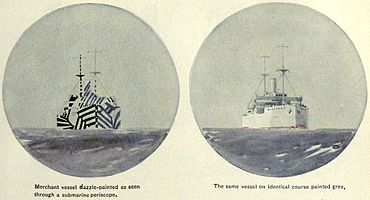
Claimed effectiveness: Artist's conception of a U-boat commander's periscope view of a merchant ship in dazzle camouflage (left) and the same transport uncamouflaged (correct), Encyclopædia Britannica, 1922. The conspicuous markings obscure the ship's heading.
Wilkinson advocated "masses of strongly contrasted colour" to confuse the enemy about a ship'south heading.[d] [1] Thus, while dazzle, in some lighting conditions or at close ranges, might really increase a ship's visibility,[15] the conspicuous patterns would obscure the outlines of the ship's hull (though absolutely not the superstructure[xvi]), disguising the ship'due south correct heading and making it harder to hitting.[8]
Dazzle was created in response to an extreme demand, and hosted past an organisation, the Admiralty, which had already rejected an approach supported by scientific theory: Kerr's proposal to employ "parti-colouring" based on the known cover-up methods of disruptive coloration and countershading. This was dropped in favour of an absolutely non-scientific approach, led by the socially well-continued Wilkinson.[17] Kerr's explanations of the principles were clear, logical, and based on years of report, while Wilkinson's were simple and inspirational, based on an artist's perception.[15] The determination was likely because the Admiralty felt comfortable with Wilkinson, in sharp contrast to their awkward human relationship with the stubborn and pedantic Kerr.[17] [18]
Wilkinson claimed not to accept known of the zoological theories of camouflage of Kerr and Thayer, albeit but to having heard of the "former invisibility-idea" from Roman times.[fifteen] [e]
Possible mechanisms [edit]

Disrupting rangefinding [edit]
In 1973, the naval museum curator Robert F. Sumrall[20] (post-obit Kerr[10]) suggested a mechanism by which dazzle camouflage may have sown the kind of confusion that Wilkinson had intended for it. Coincidence rangefinders used for naval artillery had an optical mechanism, operated by a human to compute the range. The operator adjusted the machinery until the ii half-images of the target lined upwardly in a consummate moving picture. Dazzle, Sumrall argued, was intended to make that hard, as clashing patterns looked abnormal fifty-fifty when the two halves were aligned, something that became more important when submarine periscopes included such rangefinders. Patterns sometimes also included a false bow wave to make information technology difficult for an enemy to gauge the send'southward speed.[21]
Disguising heading and speed [edit]
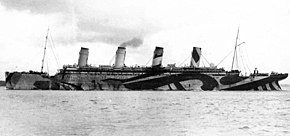
The historian Sam Willis argued that since Wilkinson knew information technology was impossible to make a send invisible with paint, the "extreme opposite"[22] was the answer, using conspicuous shapes and fierce colour contrasts to confuse enemy submarine commanders. Willis pointed out, using the HMTOlympic dazzle scheme as an example, that different mechanisms could have been at work. The contradictory patterns on the ship's funnels could imply the ship was on a dissimilar heading (as Wilkinson had said[1]). The curve on the hull below the front funnel could seem to exist a simulated bow wave, creating a misleading impression of the ship's speed. And the striped patterns at bow and stern could create confusion about which end of the ship was which.[22]
That dazzle did indeed work forth these lines is suggested by the testimony of a U-boat captain:[1]
It was not until she was inside one-half a mile that I could make out she was one send [not several] steering a course at right angles, crossing from starboard to port. The dark painted stripes on her after role made her stern announced her bow, and a wide cut of light-green paint amidships looks like a patch of water. The weather was bright and visibility good; this was the best camouflage I have ever seen.[1]
Motion dazzle [edit]
In 2011, the scientist Nicholas Due east. Scott-Samuel and colleagues presented evidence using moving patterns on a computer that human perception of speed is distorted by dazzle patterns. Nevertheless, the speeds required for motion dazzle are much larger than were bachelor to First World War ships: Scott-Samuel notes that the targets in the experiment would stand for to a dazzle-patterned Land Rover vehicle at a range of 70 m (77 yd), travelling at ninety km/h (56 mph). If such a dazzling target causes a 7% confusion in the observed speed, a rocket propelled grenade travelling that altitude in half a second would strike ninety cm (35 in) from the intended aiming signal, or seven% of the distance moved past the target. This might be enough to save lives in the dazzle-patterned vehicle, and maybe to cause the missile to miss entirely.[f] [23]
Earth War I [edit]
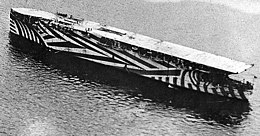
HMSArgus displaying a glaze of dazzle camouflage in 1918
[edit]
In 1914, Kerr persuaded the First Lord of the Admiralty, Winston Churchill, to prefer a class of armed forces camouflage which he chosen "parti-colouring". He argued both for countershading (following the American artist Abbott Thayer), and for disruptive coloration, both as used by animals.[24] A general order to the British fleet issued on 10 Nov 1914 advocated utilize of Kerr'due south arroyo. Information technology was applied in diverse ways to British warships such as HMSImplacable, where officers noted approvingly that the pattern "increased difficulty of accurate range finding". Even so, following Churchill's departure from the Admiralty, the Royal Navy reverted to plain greyness paint schemes,[9] informing Kerr in July 1915 that "various trials had been undertaken and that the range of conditions of lite and surroundings rendered it necessary to modify considerably any theory based upon the analogy of [the colours and patterns of] animals".[25]

A painting by Norman Wilkinson of a moonlit convoy wearing his dazzle camouflage, 1918

Official report on a camouflaged ship in 1918.
The British Army inaugurated its Cover-up Department for country utilise at the stop of 1916. At ocean in 1917, heavy losses of merchant ships to Germany's unrestricted submarine warfare campaign led to new want for camouflage. The marine painter Norman Wilkinson promoted a system of stripes and broken lines "to distort the external shape by violent colour contrasts" and misfile the enemy about the speed and dimensions of a ship.[26] Wilkinson, then a lieutenant commander on Royal Navy patrol duty, implemented the forerunner of "dazzle" beginning with the merchantman SS Industry. Wilkinson was put in charge of a camouflage unit which used the technique on large groups of merchant ships. Over 4000 British merchant ships were painted in what came to be known as "dazzle camouflage"; dazzle was also applied to some 400 naval vessels, starting in August 1917.[9] [1000]
All British patterns were unlike, first tested on pocket-size wooden models viewed through a periscope in a studio. Most of the model designs were painted by women from London's Royal Academy of Arts. A foreman then scaled upward their designs for the real affair. Painters, however, were not lonely in the projection. Creative people including sculptors, artists, and set designers designed camouflage.[28]
Wilkinson'southward dazzle camouflage was accepted by the Admiralty, fifty-fifty without practical visual cess protocols for improving performance by modifying designs and colours.[29] The dazzle camouflage strategy was adopted by other navies. This led to more scientific studies of colour options which might enhance camouflage effectiveness.[30]
After the war, starting on 27 October 1919, an Admiralty committee met to determine who had priority for the invention of dazzle. Kerr was asked whether he thought Wilkinson had personally benefited from anything that he, Kerr, had written. Kerr avoided the question, implying that he had not, and said "I make no claim to have invented the principle of parti-colouring, this principle was, of course, invented past nature".[17] He agreed as well that he had not suggested anywhere in his letters that his system would "create an illusion equally to the course of the vessel painted".[17] In October 1920 the Admiralty told Kerr that he was not seen as responsible for dazzle painting.[17] In 1922 Wilkinson was awarded the sum of £2000 for the invention.[17]
Royal Flying Corps [edit]

In the Starting time Globe War, experiments were conducted on British aircraft such every bit the Royal Flying Corps' Sopwith Camels to brand their angle and management hard to judge for an enemy gunner.[31] Similarly the Royal Navy painted some of their Felixstowe flying boats with bold disrupting lines similar to those of their ship camouflage. The effect remained dubious, just was found to reduce the incidence of the planes beingness targeted by anti-aircraft gunners on their own side.[32]
Effectiveness [edit]
Dazzle'southward effectiveness was highly uncertain at the time of the First World War, but it was however adopted both in the UK and North America. In 1918, the Admiralty analysed shipping losses, but was unable to draw clear conclusions. Dazzle ships had been attacked in 1.47% of sailings, compared to ane.12% for uncamouflaged ships, suggesting increased visibility, but equally Wilkinson had argued, dazzle was not attempting to make ships hard to see. Suggestively, of the ships that were struck by torpedoes, 43% of the dazzle ships sank, compared to 54% of the uncamouflaged; and similarly, 41% of the dazzle ships were struck amidships, compared to 52% of the uncamouflaged. These comparisons could be taken to imply that submarine commanders did take more difficulty in deciding where a ship was heading and where to aim. Furthermore, the ships painted in dazzle were larger than the uncamouflaged ships, 38% of them being over 5000 tons compared to only 13% of uncamouflaged ships, making comparisons unreliable.[8] [33]
With hindsight, also many factors (choice of colour scheme; size and speed of ships; tactics used) had been varied for it to be possible to determine which factors were significant or which schemes worked best.[34] Thayer did carry out an experiment on dazzle camouflage, but information technology failed to testify whatever reliable advantage over plain paintwork.[35]
The American data were analysed past Harold Van Buskirk in 1919. Most 1,256 ships were painted in dazzle between ane March 1918 and the end of the war on 11 November that year. Amidst American merchantmen 2,500 tons and over, 78 uncamouflaged ships were sunk, and only 18 inconspicuous ships; out of these 18, eleven were sunk by torpedoes, four in collisions and 3 by mines. No U.s.a. Navy ships (all camouflaged) were sunk in the period.[36] [h]
World War II [edit]
Ships [edit]
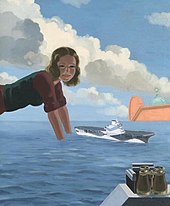
Dazzle under evolution: the "Outside Viewing-tank" on the roof of the Directorate of Cover-up Naval Section, Leamington Spa.[37] James Yunge-Bateman, 1943
However constructive dazzle camouflage may take been in World War I, it became less useful equally rangefinders and especially aircraft became more advanced, and, past the time it was put to use again in World War 2, radar farther reduced its effectiveness. Still, information technology may nevertheless have confounded enemy submarines.[38]
In the Royal Navy, dazzle paint schemes reappeared in January 1940. These were unofficial, and competitions were oftentimes held between ships for the all-time camouflage patterns. The Royal Navy's Camouflage Department came up with a scheme devised by a young naval officer, Peter Scott, a wildlife artist, which were developed into the Western Approaches Schemes. In 1942 the Admiralty Intermediate Disruptive Pattern came into use, followed in 1944 past the Admiralty Standard Schemes.[39] Dazzle patterns were tested on pocket-size model ships at the Royal Navy's Directorate of Camouflage in Leamington Spa; these were painted and so viewed in a shallow tank on the building'south roof.[37] [40]
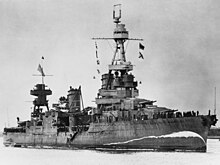
The United States Navy implemented a camouflage painting programme in Earth War II, and applied it to many ship classes, from patrol craft and auxiliaries to battleships and some Essex-class aircraft carriers. The designs (known as Measures, each identified with a number) were not arbitrary, but were standardised in a process which involved a planning stage, then a review, and then armada-wide implementation.[38] Not all United States Navy measures involved dazzle patterns; some were simple or even totally unsophisticated, such every bit a false bow wave on traditional Haze Grey, or Deck Blueish replacing grey over part or all of the ship (the latter to counter the kamikaze threat).[41] Dazzle measures were used until 1945; in February 1945 the United States Navy's Pacific Armada decided to repaint its ships in not-dazzle measures against the kamikaze threat, while the Atlantic Fleet continued to use dazzle, ships being repainted if transferred to the Pacific.[42]
Nazi Germany's Kriegsmarine first used camouflage in the 1940 Norwegian campaign. A broad range of patterns were authorised, but most usually black and white diagonal stripes were used. Most patterns were designed to hibernate ships in harbour or almost the coast; they were often painted over with manifestly greyness when operating in the Atlantic.[43] [44]
Aircraft [edit]
In 1940, the U.s.a. Navy conducted experiments with dazzle-type camouflage for aircraft. The artist McClelland Barclay designed "pattern camouflage" schemes for US Navy aircraft such as the Douglas TBD Devastator and the Brewster F2A Buffalo to make it hard for the enemy to gauge the shape and position of the aircraft.[45] The camouflaged aircraft were flown in combat, but the effect was institute not to be satisfactory.[46]
Since World War Two [edit]
[edit]
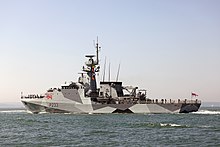
HMS Tamar (P233) painted in the 2021 Imperial Navy version of dazzle cover-up
In 2019, the Royal Canadian Navy frigate HMCS Regina was painted in a 1944 design to commemorate the 75th anniversary of the Battle of the Atlantic; the pattern was described variously as "dazzle" and "disruptive".[48] In 2021, the Royal Navy painted HMS Tamar, a river class patrol ship in patches of black and four shades of grey. It described this as "dazzle camouflage", making the transport the first Purple Navy vessel to accept such a paint scheme since the Second World State of war. It stated that the scheme was "more nearly supporting the unique identity of the squadron" than for concealment.[49]
Arts [edit]
The abstruse patterns in dazzle camouflage inspired artists including Picasso. With feature hyperbole,[l] he claimed credit for camouflage experiments, which seemed to him a quintessentially Cubist technique.[iii] In a conversation with Gertrude Stein soon later he showtime saw a painted cannon trundling through the streets of Paris he remarked, "Yes it is nosotros who made it, that is cubism".[xiv] In Great britain, Edward Wadsworth, who supervised dazzle camouflage painting in the war, created a series of canvases later the war based on his dazzle work on ships. In Canada, Arthur Lismer used dazzle ships in some of his wartime compositions.[51] In America, Burnell Poole painted canvases of United states of america Navy ships in dazzle camouflage at sea.[52] The historian of camouflage Peter Forbes comments that the ships had a Modernist look, their designs succeeding equally advanced or Vorticist art.[17]
In 2007, the art of cover-up, including the evolution of dazzle, was featured as the theme for a testify at the Imperial State of war Museum.[53] In 2009, the Fleet Library at the Rhode Island Schoolhouse of Design exhibited its rediscovered collection of lithographic printed plans for the camouflage of American World War I merchant ships, in an exhibition titled "Bedazzled".[54]
In 2014, the Centenary Art Committee backed 3 dazzle cover-up installations in U.k.:[55] Carlos Cruz-Diez covered the pilot ship MVEdmund Gardner in Liverpool's Canning Dock with bright multi-coloured dazzle artwork, as role of the urban center's 2014 Liverpool Biennial fine art festival;[56] and Tobias Rehberger painted HMSPresident, anchored since 1922 at Blackfriars Bridge in London, to commemorate the use of dazzle, a century on.[57] [58] Peter Blake was commissioned to design exterior paintwork for MVSnowdrop, a Mersey Ferry, which he chosen "Everybody Razzle Dazzle", combining his trademark motifs (stars, targets etc.) with First Earth War dazzle designs.[59]
-

Two American ships in dazzle camouflage, painted by Burnell Poole, 1918
-

-
Other uses [edit]
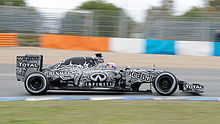
Red Bull RB11 racing automobile in camouflage livery
In noncombatant life, patterns reminiscent of dazzle camouflage are sometimes used to mask a examination car during trials, to make determining its exterior pattern hard.[60] During the 2015 Formula 1 testing period, the Red Balderdash RB11 car was painted in a scheme intended to confound rival teams' power to analyse its aerodynamics.[61] The designer Adam Harvey has similarly proposed a form of camouflage reminiscent of dazzle for personal camouflage from face-detection technology, which he calls computer vision dazzle. Its intention is to block detection by facial recognition technologies such every bit DeepFace "by creating an 'anti-face'".[62] It uses occlusion, roofing certain facial features; transformation, altering the shape or colour of parts of the face; and a combination of the two.[63]
The Sea Shepherd Conservation Society has used dazzle patterns on its fleet since 2009 for recognition rather than cover-up.[64]
Notes [edit]
- ^ Wilkinson said "The primary object of this scheme was not and then much to cause the enemy to miss his shot when actually in firing position, but to mislead him, when the transport was first sighted, as to the right position to have up. Dazzle was a method to produce an effect by paint in such a manner that all accepted forms of a send are broken up by masses of strongly contrasted color, consequently making it a thing of difficulty for a submarine to decide on the exact grade of the vessel to be attacked." For case, an enemy submarine might position itself poorly, leaving itself at long range or out of range altogether.[1] Wilkinson farther wrote that dazzle was designed "non for depression visibility, but in such a way equally to intermission upwardly her class and thus confuse a submarine officer every bit to the course on which she was heading".[2]
- ^ For example, Wadsworth's Dazzle-ships in Drydock at Liverpool, 1919.
- ^ Kerr idea this because, equally shown in the rangefinder eyepiece image, masts provide ideal verticals to align.
- ^ Wilkinson said that dazzle was a "method to produce an effect past paint in such a way that all accepted forms of a send are broken up past masses of strongly contrasted color, consequently making it a matter of difficulty for a submarine to make up one's mind on the verbal class of the vessel to be attacked."[1]
- ^ Vegetius had recorded "Venetian bluish" (bluish-green, the same colour as the sea) was used for ship cover-up during the Gallic Wars, when Julius Caesar had sent his scout ships to get together intelligence along the coast of Britain.[nineteen]
- ^ The equivalent for naval artillery at a range of vii,000 m (7,700 yd) would require a ship to travel at 7000 × 90/70 = 9,000 km/h (four,900 kn; 5,600 mph) to achieve motion dazzle.
- ^ In Baronial 1917, HMSAlsatian was painted in a dazzle pattern, perhaps the start Purple Navy vessel to be camouflaged in this way.[27]
- ^ As Buskirk claimed, less than 1% of the US merchant ships painted in dazzle were lost; just without knowing the number of non-camouflaged ships, it is not possible to calculate the comparative rates of loss.
References [edit]
- ^ a b c d e f g Newark, Tim (2007). Camouflage. Thames and Hudson / Imperial State of war Museum. p. 74.
- ^ Wilkinson, Norman (1969). A Brush with Life. Seeley Service. p. 79.
- ^ a b Campbell-Johnson, Rachel (21 March 2007). "Camouflage at IWM". The Times.
- ^ Marter, Joan Grand. The Grove Encyclopedia of American Art, Oxford University Press, 2011, vol. 1, p. 401.
- ^ Saunders, Nicholas J.; Cornish, Paul. (eds). Contested Objects: Fabric Memories of the Not bad War, Routledge, 2014. Jonathan Black: "'A few broad stripes': Perception, Deception, and the 'Dazzle Ship' miracle of the Get-go World War.", pp. 190–202.
- ^ Newbolt, Sir Henry John Newbolt. Submarine and Anti-Submarine, Longmans, Green and Co, 1919. p. 46. "You expect long and hard at this dazzle-ship. She doesn't give you any awareness of existence dazzled; but she is, in some queer way, all wrong".
- ^ Deer, Patrick. Culture in Camouflage: War, Empire, and Modern British Literature. Oxford University Printing, 2009, p. 46.
- ^ a b c Forbes, 2009. p. 96
- ^ a b c Murphy, Hugh; Bellamy, Martin (April 2009). "The Dazzling Zoologist: John Graham Kerr and the Early Evolution of Transport Cover-up" (PDF). The Northern Mariner. XIX (2): 171–192.
- ^ a b c d e f g h i Forbes, 2009. pp. 87–89
- ^ Roosevelt, Theodore (1911). "Revealing and concealing coloration in birds and mammals". Bulletin of the American Museum of Natural History. 30 (Article 8): 119–231. hdl:2246/470.
- ^ Wright, Patrick (23 June 2005). "Cubist Slugs. Review of DPM: Disruptive Blueprint Textile; An Encyclopedia of Camouflage: Nature – Military – Culture by Roy Behrens". London Review of Books. 27 (12): 16–20.
- ^ Wilkinson, Norman (iv April 1939). "Letters. Camouflage". The Times.
- ^ a b Glover, Michael. "Now you see it... At present you don't" The Times. x March 2007.
- ^ a b c Forbes, 2009. pp. 90–91
- ^ Forbes, 2009. p. 97
- ^ a b c d e f thou Forbes, 2009. pp. 98–100
- ^ Forbes, 2009. p. 92.
- ^ Murphy, Robert Cushman (January 1917). "Marine camouflage". The Brooklyn Museum Quarterly. Brooklyn Institute of Arts and Sciences. 4–6: 35–39.
- ^ "Robert F. Sumrall". Navy G Associates. Archived from the original on 18 January 2016. Retrieved 7 January 2016.
- ^ Sumrall, Robert F. (February 1973). Send Camouflage (WWII): Deceptive Art. United States Naval Plant Proceedings. pp. 67–81.
- ^ a b Willis, Sam. "How did an artist help Britain fight the war at sea?". British Broadcasting Corporation. Retrieved 7 January 2016.
- ^ Scott-Samuel, Nicholas Due east.; Baddeley, Roland; Palmer, Chloe Due east.; Cuthill, Innes C. (2011). "Dazzle Camouflage Affects Speed Perception". PLOS ONE. 6 (6): e20233. Bibcode:2011PLoSO...620233S. doi:10.1371/periodical.pone.0020233. PMC3105982. PMID 21673797.
- ^ Forbes, 2009. p. 87
- ^ Forbes, 2009. p. 88
- ^ Fisher, Mark. "Secret history: how surrealism can win a war," The Times. viii January 2006.
- ^ Raven, Alan. "The Development of Naval Camouflage 1914–1945 Role I". Transport Camouflage . Retrieved 22 May 2015.
- ^ Paulk, Ann Bronwyn (Apr 2003). "False Colors: Art, Design, and Modernistic Cover-up (review)". Modernism/modernity. 10 (2): 402–404. doi:10.1353/mod.2003.0035. S2CID 143681624.
- ^ Williams, 2001. p. 35
- ^ Williams, 2001. p. xl
- ^ "Camouflage during the First World War". Imperial War Museum. Retrieved five June 2020.
- ^ D'Alto, N. "Inventing the Invisible Airplane – When camouflage was fine art". Air & Infinite Magazine. Retrieved 5 June 2020.
- ^ Hartcup, Guy (1979). Camouflage: the history of darkening and deception in state of war. Pen & Sword.
- ^ Scott-Samuel, Nicholas East; Baddeley, Roland; Palmer, Chloe E; Cuthill, Innes C (June 2011). "Dazzle Camouflage Affects Speed Perception". PLoS ONE. six (6): e20233. Bibcode:2011PLoSO...620233S. doi:10.1371/periodical.pone.0020233. PMC3105982. PMID 21673797.
- ^ Stevens, M.; Yule, D.H.; Ruxton, Chiliad.D. (2008). "Dazzle coloration and casualty movement". Proceedings of the Royal Order B. 275 (1651): 2639–2643. doi:10.1098/rspb.2008.0877. PMC2605810. PMID 18700203.
- ^ Buskirk, Harold Van (1919). "Camouflage". Transactions of the Illuminating Engineering science Guild. xiv (v): 225–229. Archived from the original on 2016-03-04.
- ^ a b Rodger, James (20 July 2016). "Leamington camouflage unit to be celebrated in new art exhibition". Coventry Telegraph.
- ^ a b Sumrall, Robert F. (February 1973). "Ship Camouflage (WWII): Deceptive Fine art". United States Naval Establish Proceedings: 67–81.
- ^ Warneke, Jon; Herne, Jeff. "Majestic Navy Colour Chips". Steelnavy.com. Retrieved 7 January 2012.
- ^ "Directorate of Camouflage (Naval Section) at Work, Leamington Spa, 1941". Majestic War Museum. Retrieved 21 April 2020.
- ^ Curt, Randy. "USN Camouflage Measures". Snyder and Short Enterprises. Retrieved 27 July 2015.
- ^ Brand, C. Fifty. (26 Feb 1945). "Camouflage Instructions – Carriers, Cruisers, Destroyers, Destroyer Escorts, Assigned to the Pacific Armada". Navy Section Bureau of Ships. Retrieved 8 April 2013.
- ^ Asmussen, John. "Bismarck Paint Schemes". Retrieved 17 July 2015.
- ^ Asmussen, John; Leon, Eric (2012). High german Naval Camouflage Volume I 1939–1941. Seaforth Publishing. ISBN978-1-84832-142-7.
- ^ Elias, A. (2011). Camouflage Australia: Art, nature, scientific discipline and war. Sydney Academy Press. pp. 186–188. ISBN978-1920899738.
- ^ "McClelland Barclay (1891-1943)". U.s. Naval History and Heritage Command. 31 March 2015. Archived from the original on 13 March 2015. Retrieved 5 June 2020.
In mid-1940, Barclay prepared designs for experimental camouflage for different types of Navy combat aircraft. Evaluation tests, however, showed that design camouflage was of little, if whatsoever, use for the aircraft.
- ^ "NH 96165 Douglas TBD-1 torpedo Plane". US Naval History and Heritage Command. Retrieved 5 June 2020.
- ^ "New HMCS Regina paint job harkens dorsum to Battle of the Atlantic". CKOM News. xi Nov 2019. Retrieved 22 June 2021.
- ^ "HMS Tamar dazzles as iconic wartime pigment scheme is revived". Royal Navy. 27 Apr 2021. Retrieved 12 April 2022.
- ^ Forbes, 2009. p. 104
- ^ Kelly, Gemey. "The Group of Seven and the Halifax Harbour Explosion: Focus on Arthur Lismer" (PDF). Canadian Dissemination Corporation. Retrieved 10 June 2015.
- ^ ""A Fast Convoy" by Burnell Poole". Naval History and Heritage Control. Retrieved 12 January 2016.
- ^ Newark, Tim (2007). Camouflage. Thames & Hudson with Imperial War Museum. pp. Within cover.
- ^ "Armada Library Special Collections: Dazzle Camouflage". Archived from the original on xvi November 2011. Retrieved 7 Jan 2016.
- ^ "Dazzle Ships". Archived from the original on 9 October 2014. Retrieved 7 January 2016.
- ^ Dixon, David (1 May 2015). "SJ3489 : Dazzle Ship, Canning Graving Dock". Geograph. Archived from the original on 22 June 2018. Retrieved 4 Feb 2019.
- ^ Brown, Mark (14 July 2014). "First world war dazzle painting revived on ships in Liverpool and London". The Guardian . Retrieved 14 July 2014.
- ^ "HMS President Dazzle Transport London". Retrieved 22 May 2015.
- ^ Jones, Catherine (two April 2015). "Razzle Dazzle Mersey Ferry unveiled by Sir Peter Blake". Liverpool Echo.
- ^ Rabe, Mattias (9 March 2015). "Lamborghini kör med vidvinkel-extraljus i Norrland" (in Swedish). Teknikens Värld. Retrieved nine March 2015.
- ^ Clarkson, Tom. "Formula One Testing:Tom Clarkson'southward Jerez Circular-Upward". BBC Sports. BBC News. Retrieved 22 February 2015.
- ^ Burns, Janet (21 Apr 2015). "The Anti-Surveillance Land: Clothes and Gadgets Block Face Recognition Technology, Misfile Drones and Make You lot (Digitally) Invisible". AlterNet . Retrieved 3 November 2015.
- ^ Feng, Ranran; Prabhakaran, Balakrishnan (2013). "Facilitating Fashion Cover-up Art". Proceedings of the 21st ACM International Conference on Multimedia. MM 'thirteen. ACM: 793–802. doi:10.1145/2502081.2502121. ISBN978-1-4503-2404-five. S2CID 1547688.
- ^ "Bounding main Shepherd Fleet Gets Prepare for Upcoming Campaigns". Bounding main Shepherd. 15 Apr 2011. Retrieved 5 Jan 2016.
Sources [edit]
- Forbes, Peter (2009). Dazzled and Deceived: Mimicry and Camouflage. Yale Academy Press. ISBN 978-0-300-17896-8.
- Williams, David (2001). Naval camouflage, 1914–1945: a complete visual reference. Naval Establish Printing. ISBN 978-1-55750-496-8.
Further reading [edit]
- Behrens, Roy R., ed. (2012). Send Shape: A Dazzle Camouflage Sourcebook. Bobolink Books. ISBN 978-0-9713244-7-3.
External links [edit]
- Newly discovered dazzle plans at Rhode Island School of Pattern
- The evolution of naval camouflage 1914–1945
- Artists and other contributors to camouflage in the 20th century
- Camoupedia: dazzle cover-up
- Razzle dazzle cover-up
- "She'due south All Dressed Up For Peace", Popular Science (February 1919), p. 55.
- "Fighting the U-Boat with Pigment", Popular Scientific discipline (Apr 1919), pp. 17–19.
- Destroyer Escort Historical Museum: USS Slater painted in 1945 Dazzle camouflage
- United states of america Navy PT Boats in Dazzle Camouflage
- Catalogue of US Navy World War 2 ships in Dazzle Cover-up
Source: https://en.wikipedia.org/wiki/Dazzle_camouflage
0 Response to "How to Draw Plane From Ww1"
Enviar um comentário