Is It Standard to Include Plumdomain7 Plans in Architectural Drawings
| 2.one INTRODUCTION | |||
| Not also long ago, it was predicted past some that by the start of the 21st century, blueprints would become obsolete and no longer exist used on construction sites. Information technology was further suggested that construction information would essentially be read off computer screens rather than design drawings. This would not just exist more efficient, but it would as well save a tremendous amount of newspaper. These predictions did non materialize. Although construction plans are read regularly on estimator screens and are being sent via computer to job sites, newspaper pattern drawings remain the preferred medium on building sites. In many parts of the world, manual drafting and design drawings are yet the norm. Design reading consists substantially of finding information on prints. The information may be displayed on a drawing in the form of lines, notes, symbols, and schedules. The items are typically located either in the title block or in the field of the cartoon (i.e., anywhere within the border lines outside the title block). You should also keep in mind that blueprints typically come in sets. A set of prints for a single-family residence may comprise no more than than a few sheets, whereas on a large project a complete drawing set up may contain scores of sheets for different disciplines (e.m., architectural, structural, electric, mechanical, plumbing, etc.). The general procedure and sequence for reading blueprints can be summarized every bit follows: 1. Verify that the ready of drawings and specifications is consummate. Likewise, verify that the documents in hand are the most current. 2. Start by reviewing the site or plot programme to better encompass the setting of the building and the general topography. | |||
| Copyright © 2009 past The McGraw-Hill Companies, Inc. Click here for terms of use. | 9 | ||
| 10 Chapter 2 | ||
| 3. Visually scan the architectural drawings to get a better overall understanding of the project. Wait at the title block to excerpt whatsoever general information pertaining to the project that may exist needed (consultant's proper name, client'southward proper noun, project title, drawing number, etc.). Check for unusual or complicated features that may touch on how the building is constructed. In detail review the elevations and sections and the materials used. 4. Review the foundation plan and read the general notes to get a ameliorate agreement of the construction specifications and other data relevant to the drawing. Also expect at the relevant building details. v. Review the structure's wall construction and the cloth and methods used. Also study the details showing how the wall is to sit on the designed foundations and which walls if whatever are load-begetting and which are not. 6. Review the plumbing, mechanical, and electrical drawings. vii. Check all notes on these plans to encounter if there have been whatsoever revisions. Cheque to see if the edifice codes have been taken into account. Ensure that the notes on the drawings are clear and that there is no ambiguity. 8. Review the specifications and compare them to the drawings. (Specifications normally take priority over drawings.) If there are discrepancies, the consultant should exist notified. 2.2 TECHNICAL Drawing | ||
| Also known as drafting, technical drawing is the do of creating accurate representations of objects for architectural and technology needs. A practitioner of the discipline is known as a drafter. Today the mechanics of the drafting task have considerably changed through the utilise of CADD computer systems, but regardless of whether a drawing is drawn manually or with estimator assistance, it must be reproducible. Manual Drafting Bones drafting procedure consists of placing a piece of paper (or other material) on a smooth surface with correct-angle corners and straight sides–typically a drafting table. A sliding straightedge unremarkably known every bit a t-foursquare is so placed on ane of the sides, allowing it to slide across the side of the tabular array and over the surface of the paper (Effigy two.i). Parallel lines tin be drawn by just moving the t-square and running a pencil or technical pen along the edge. The t-foursquare is also used as a ways to hold other tools such every bit gear up squares or triangles. To practice this, the drafter places ane or more than triangles of known angles on the t-square (which is itself at right angles to the edge of the table) and and so draws lines to the angles chosen on the sheet. Modernistic drafting tables (which in the United States are rapidly existence replaced by CAD stations) come up equipped with a parallel rule that is supported on both sides of the tabular array to slide over the tracing paper. Since it is secured on both sides of the drafting tabular array, lines fatigued forth the edge are parallel. The drafter also has other tools at his/her disposal that are used to draw curves and circles, including compasses (used for drawing simple arcs and circles) and French curves (which typically consist of a piece of plastic with complex curves on information technology). Another tool used is the spline, which is a piece of condom-coated articulated metal that can be manually bent to most curves. Figure 2.2 is an illustration of some of the templates and instruments used in manual drafting. | ||
| Blueprints and Construction Drawings: A Universal Language | eleven | ||
| Drafting templates allow the drafter to consistently recreate recurring objects in a drawing without continuously having to reproduce them from scratch. This is specially useful when using common symbols: for example, in the context of stagecraft, a lighting designer volition typically draw from the United States Institute for Theatre Technology (USITT) standard library of lighting-fixture symbols to point the position of a common fixture across multiple positions. Templates can unremarkably be purchased from various vendors, ordinarily customized to a specific task, only it is as well non uncommon for a drafter or designer to create customized templates. This basic drafting system requires an authentic table, and careful attending should be given to the positioning of the tools. A common fault is to allow the triangles to push button the peak of the t-square down slightly, thereby throwing off all the angles. Even tasks as simple every bit drawing 2 angled lines meeting at a point require a number of moves of the t-foursquare and triangles. In general, drafting oft proves to exist a time-consuming process. A solution to these issues was the introduction of the so-called mechanical drafting machine, an application of the pantograph that allowed the drafter to brand an accurate right angle at whatsoever indicate on the folio quite quickly. These machines oft included the ability to change the angle, thereby removing the need for the employ of triangles every bit well. In addition to the complete mastery of the mechanics of drawing lines, circles, and text onto newspaper (with respect to the detailing of physical objects), the drafting try requires a skilful understanding of geometry, trigonometry, spatial comprehension, and above all a high standard of precision and accuracy as well as close attending to detail. | |||
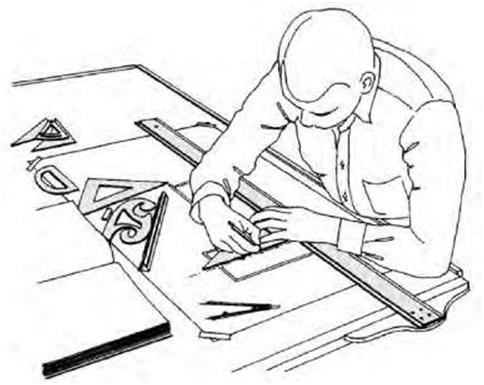 | |||
| Effigy 2.1 A drafter using a typical drawing board, t-foursquare, and other instruments (subsequently Muller, Edward J., et al.: Architectural Drawing and Light Structure, 5th ed., Englewood Cliffs: Prentice Hall, 1999). | |||
| 12 | Chapter two | ||
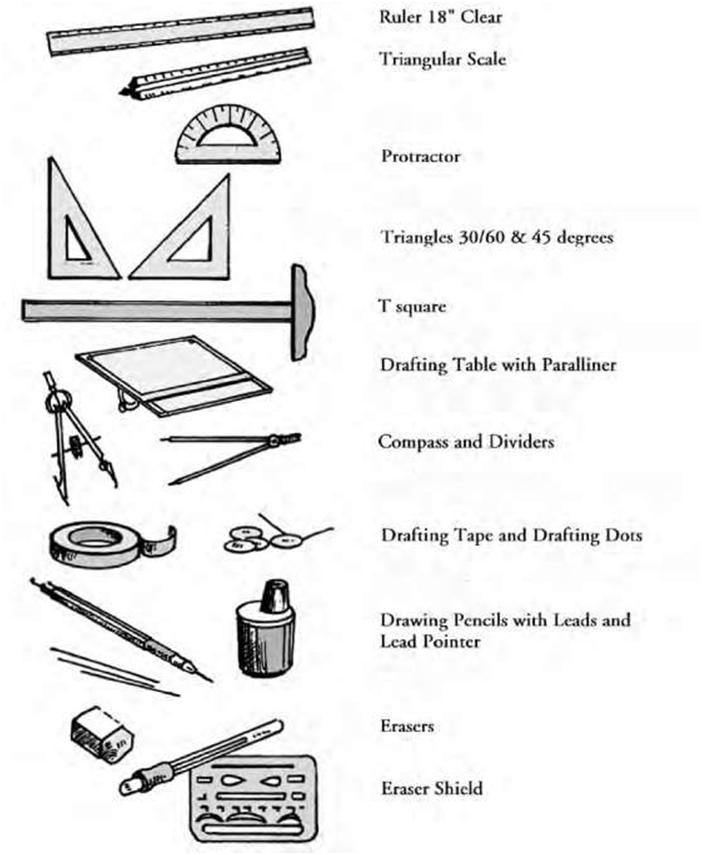 | |||
| Figure 2.two Some of the tools, aids and materials used in transmission drafting (from Montague, John: Bones Perspective Drawing: A Visual Arroyo, 3rd ed., New York: John Wiley and Sons, 1998). | |||
| Blueprints and Structure Drawings: A Universal Language | 13 | ||
| Lettering Lettering is used on construction drawings as a means to provide written information. A construction sketch or drawing without lettering rarely communicates an acceptable description of the object. It is virtually ever necessary to provide boosted labels, notes, and dimensions to clarify the size, blazon of materials, and location of the component. Drawings are therefore a means of communication of information to others, and text generally is one of the principal mediums to transmit information in the form of notes, titles, dimensions, etc. Lettering should enhance a cartoon past making it like shooting fish in a barrel to interpret and pleasant to wait at; it should non detract from the drawing or exist illegible or unsightly to expect at. Legibility and consistency are the key ingredients to good lettering. Architectural lettering is often done using all uppercase letters, and abbreviations are commonly used to save space and drafting time (refer to the abridgement list in the Appendix). When necessary, specific notes can exist placed close to the detail being identified or continued to it with leader lines. Although most of the lettering done today on construction drawings is computer-generated, skill in freehand lettering adds style and individuality to a designer'due south work. And in whatsoever style of lettering, uniformity is important. This applies to height, proportion, strength of lines, spacing of letters, and spacing of words. Messages should be spaced by visually equalizing the background areas between the letterforms and not by mechanically measuring the distance between the extremities of each letter (Effigy ii.iii). The utilize of low-cal horizontal guidelines (using a hard lead such as a 4H) should be proficient to command the acme of messages, while low-cal vertical or inclined guidelines are required to keep the messages compatible. Words should be spaced well apart, while messages should exist spaced closely within words. A cursory examination of the various alphabets and typefaces in use today conspicuously shows that the vast majority fit into one of iv bones classifications as outlined below (Figure 2.four): Roman: perfected by the Greeks and Romans and later modernized in the 18th century, the Roman alphabet displays enormous grace and dignity and is considered by many to be the about elegant typeface family. Gothic: this alphabet is the base from which our unmarried-stroke technical lettering has evolved and is the primary mode used past the majority of today's designers. Information technology is an easily read and simply executed style that has been in utilize for many years equally a commercial, block-type letter. Its main characteristic is the uniformity in width of all of the strokes. Modifications of this alphabetic character include inclined, squared, rounded, boldface, lightface, and serif. Script: script alphabets are cursive in nature and resemble handwriting. The lowercase messages are interconnected when used within words or judgement beginnings. Their characteristic free-flowing strokes impart a sense of delicacy and personal temperament and are non considered advisable for general utilise in technical drawing. Text (Former English): originally used by European monks for recording religious manuscripts, this alphabet is characterized by the use of strokes of unlike width, due to the original employment of a apartment quill pen. This alphabet is rarely used in modern work and is not considered suitable for technical cartoon considering it is difficult to read and draw. All of the above typefaces can exist produced in italic (which has inclined, lightface, and curved characteristics). The character of the typeface used should always be appropriate to the pattern beingness presented. Today there is a large body of well-designed typefaces available in the form of pressure level-sensitive dry-transfer sheets in add-on to computerized typography. | |||
| xiv | Chapter 2 | |||
| T¥pog^ap/iY abcdef$h/ji:!nnopqr5>tuvwxyz abcdefghijklmnopqrstuvwxyz 0123456789 AieDEFiHUK howdy i p q v xi m w 11 f; | ||||
| i^^©DK]i | G tS | |||
| Right spacing of equal areas | Incorrect spacing of letter forms | |||
| SERIFS Serifs | ||||
| Figure 2.3 Examples of some of the more than pop typefaces used today. | ||||
| ROMAN GOTHIC | ||||
| Figure 2.iv Most alphabets currently in use can be classified into iv basic categories: Roman, gothic, script and text. | ||||
| Blueprints and Structure Drawings: A Universal Language 15 2.3 Reckoner-AIDED DRAFTING (CAD) AND COMPUTER-AIDED DESIGN AND DRAFTING (CADD) | ||
| Moving from transmission drafting to reckoner-aided pattern and drafting was an of import step in terms of the potential of today's applied science. CAD originally meant computer-aided drafting because of its original use equally a replacement for traditional drafting. Now it unremarkably refers to computer-aided blueprint to reflect the fact that modern CAD tools do more than just drafting (Figures ii.5A, B, and C). Related acronyms are CADD, which stands for calculator-aided blueprint and drafting; CAID, for estimator-aided industrial design; and CAAD, for computer-aided architectural design. All of these terms are substantially synonymous, merely there are a few subtle differences in meaning and awarding. CAM (computer-aided manufacturing) is also oft used in a similar way or as a combination (CAD/CAM). When nosotros apply figurer-aided pattern and drafting (CADD), certain questions ascend that nosotros never recollect of when working on the drawing board. Although with CAD or CADD nosotros practise not use the typical drawing-board tools, nosotros are still required to design or make a cartoon. CADD is an electronic tool that enables you to quickly create authentic drawings with the use of a computer. In fact, an experienced reckoner drafter can usually produce a construction drawing in less time than it would have if it was washed manually. Moreover, dissimilar the traditional methods of making drawings on a cartoon board, with CADD systems you can create professional drawings but by using a mouse and clicking buttons on the keyboard. Furthermore, drawings created with CADD have many advantages over traditionally produced drawings. In addition to the fact that they are smashing, accurate, and highly presentable, they can be easily modified and converted to a diversity of formats. In addition, CADD-generated drawings can be saved on the computer, a flash, a CD, or an external hard bulldoze in lieu of vellum or Mylar sheets that require the use of large storage cabinets for filing. A decade ago CADD was largely used for specific engineering applications that required loftier precision, and considering of CADD's high production costs, non many professionals could afford it. In contempo years, withal, computer prices have dropped significantly, and professionals are increasingly taking advantage of this by adopting CADD programs. In that location is a wealth of CADD programs available on the market today. Some are intended for general cartoon work, while others are designed for specific technology applications. There are programs that enable you lot to practice 2D drawings, 3D drawings, renderings, shadings, punch lists, infinite planning, structural pattern, pipage layouts, HVAC, plant blueprint, project direction, and other applications. Today we tin can find a CADD programme for almost every applied science discipline that comes to mind. CADD Presentations Although CADD is primarily intended for unmarried-line drafting and has very limited capabilities to create artistic impressions, CADD's 3D and rendering features are quite impressive. A 3D model of an object can be created and viewed from various angles and, with correct shading and rendering, can be made to look very realistic. With CADD you can create fine drawings with hundreds of colors, line types, hatch patterns, presentation symbols, text styles, and other features. Fifty-fifty if you don't like something about your presentation after you have finished it, you tin instantly change it (Effigy 2.half dozen). Almost CADD programs have a number of set up-made presentation symbols and hatch patterns available that tin be used to enhance the look of drawings. When drawing a site plan, for instance, a draftsperson can instantly add together tree symbols, shrubs, pathways, human being figures, and other landscape elements to create a professional-looking site program. Similarly, an builder tin can use set-made symbols | ||
| sixteen | Chapter 2 | ||
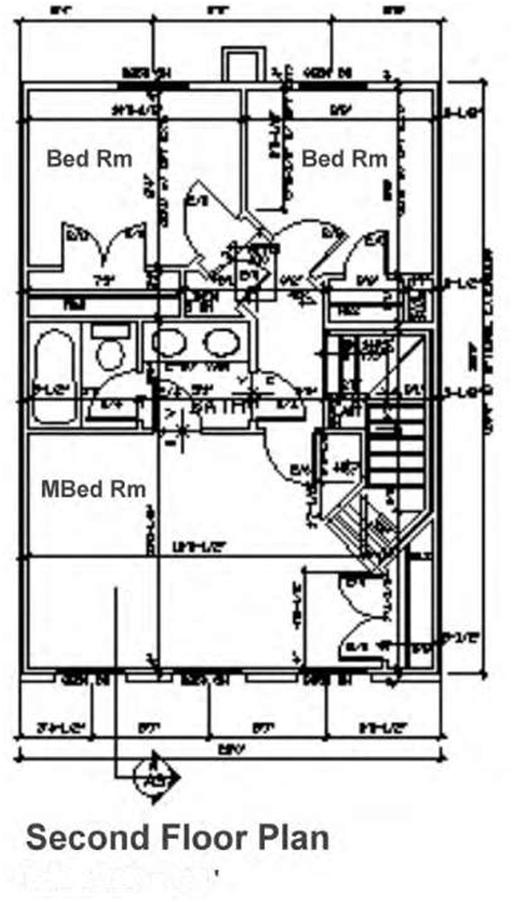 | |||
| Scale: i/4″ = TO' Figure 2.5A Example of a type of CADD-generated drawing. | |||
| Blueprints and Structure Drawings: A Universal Linguistic communication | 17 | ||
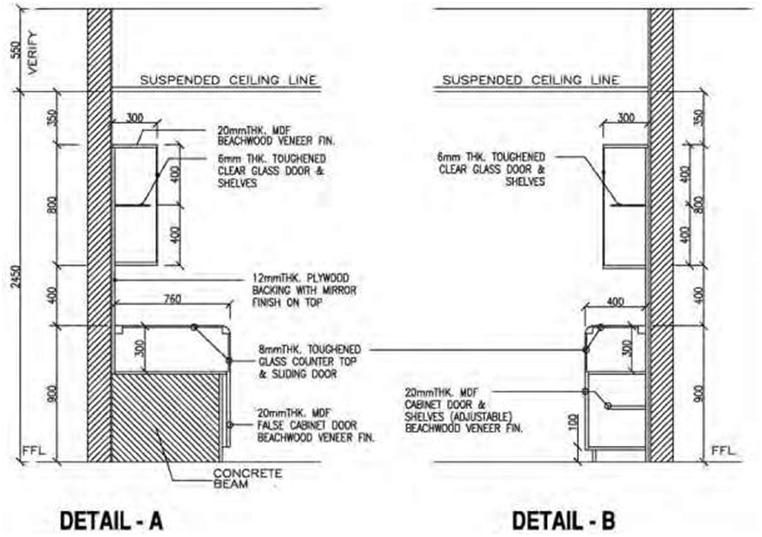 | |||
| Figure 2.5B Example of a type of CADD-generated drawing. | |||
| of doors, windows, and furniture to make a presentation. Architects and designers as well sometimes blueprint their own symbols when working with CADD. In addition to preparing impressive presentations on paper, CADD can be used to make on-screen presentations. Ideas can be presented on-screen by simply plugging the computer to a projector. Advanced CADD programs also permit yous to created animated images. You can show how a building would announced while walking through information technology or how a machine assembly will operate as different machine parts move. | |||
| Editing Flexibility One of the main advantages of CADD is that it allows quick alterations to drawings. Modifications can be fabricated with pinpoint accurateness. It takes only seconds to do a chore that would otherwise accept hours on a drawing board to produce. In many cases you lot may not even have to erase a section to make the change. | |||
| 18 | Affiliate two | ||
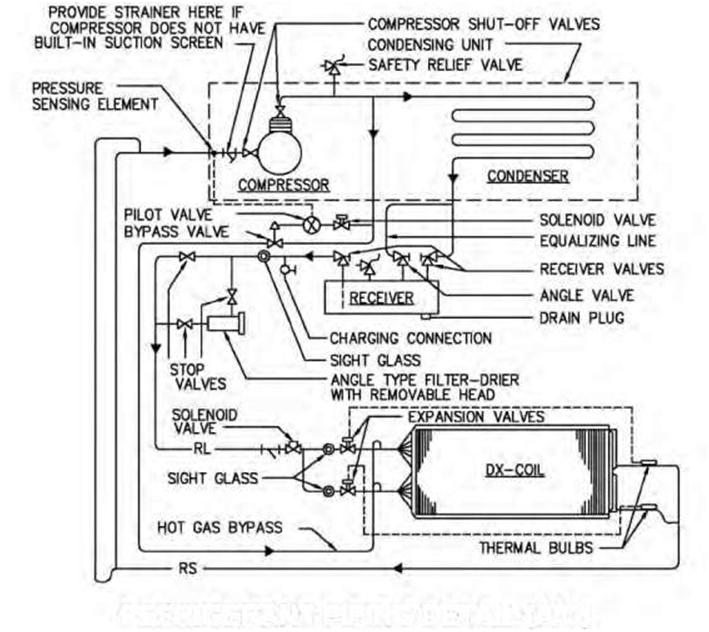 | |||
| REFRIGERANT PIPING Detail (A/C) Effigy two.5C Example of a type of CADD-generated cartoon. | |||
| You tin often rearrange the existing components of the drawing to fit the new shape. This enables the designer to compare various options with minimal effort. The following are some of the main editing capabilities of almost CADD systems: Move, copy, mirror, or rotate drawing elements with ease Overstate or reduce elements of a drawing Brand multiple copies of a cartoon element Add one or more drawings to another cartoon Change font style and size | |||
| Blueprints and Structure Drawings: A Universal Linguistic communication | 19 | ||
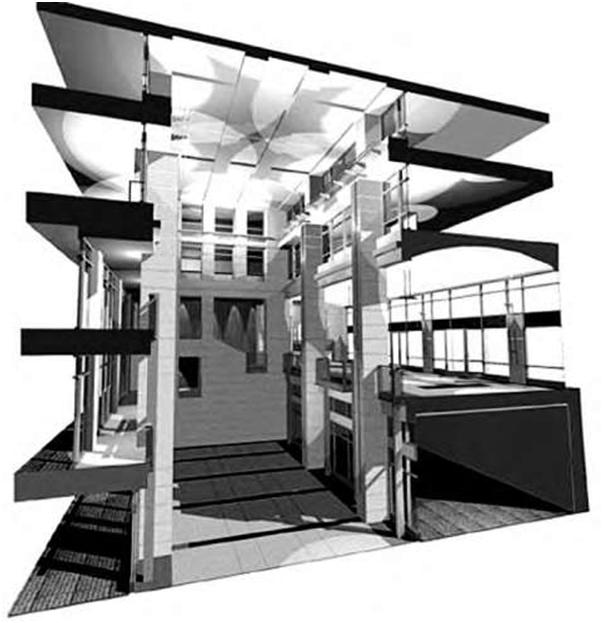 | |||
| Effigy 2.6 Case of a presentation perspective using ArchiCAD software. | |||
| Change units of measure of dimensions Stretch drawings to fit new dimensions Convert CADD drawings to other formats Units and Accuracy Levels CADD allows you to piece of work with greater accuracy. If you need to create highly authentic geometrical shapes, while avoiding time-consuming mathematical calculations, CADD is the reply. Computer-software programs similar CADD allow the designer to work with unlike units of measure, such equally architec- | |||
| 20 | Affiliate 2 | ||
| tural units, engineering units, scientific units, and surveyor'southward units. These units can be represented in various formats commonly used by professionals. When working with engineering units, the designer or drafter can specify whether all the dimensions should be represented in inches, feet-inches, centimeters, or meters. Angular units of measurement such as decimal degrees, minutes, seconds, or radians can besides exist chosen. In general, when at that place is a need to work on a large-scale drawing such every bit a plan of a township, a high degree of accuracy may non be warranted, and it may exist decided to set a lesser degree of accuracy—say ,1 foot, 0 inches. The computer will then round off all the measurements to the next foot, which avoids the use of any fractions less than a human foot. Where minute detail is required, a higher degree of accuracy such as 1/viii or 1/64 inch may be set. Drawings Storage and Admission Equally previously mentioned, it is elementary, quick, and convenient to generate or organize a CADD drawing on a computer. Most calculator hard drives have the capacity to store thousands of drawings (and this storage capacity is continuously increasing with advancing applied science), and they tin can be opened inside seconds. Some of the advantages of a figurer's electronic filing system over traditional filing include: It enables and encourages the creation of a highly organized and efficient surroundings. It contributes to large reductions in general working space. An electronic drawing does non age or become faded. Whenever a new drawing is required, it can be printed from disks. (It is important that the plan used to store the CADD files be regularly updated to avoid becoming obsolete. With continuously advancing technology, some storage methods take already get outdated, such equally zip drives and some types of disks.) Through networking electronic drawings can exist shared by several users, assuasive them to coordinate their tasks and work as a team. Different professionals such as architects, engineers, and construction managers tin use the same electronic drawings to coordinate building services. When a modification is made to a cartoon, this data becomes instantly available to all the squad members. It has thus become far easier to share data. Professionals located in dissimilar cities or countries can now instantly transmit electronic drawings to i another. They can likewise publish these drawings on the Internet for anyone to access. Nigh CADD programs incorporate special functions designed to permit you to export drawings in a format (such as .gif or .jpeg) that tin can be viewed on the Internet. Projection Reporting The computer is an ideal instrument for generating project reports, price estimates, and other business concern documents. CADD's database capabilities include the ability to link specific nongraphic information (such as text or financials) with the graphic elements of the drawing. The nongraphic information is stored in a database and can be used to set up reports. An architect, for example, can attach text attributes associated with the door and window symbols in a cartoon. These attributes include the door'due south size, material, hardware, cost, and so forth. Equipped with this information, the computer tin then automatically generate a door schedule listing all the doors and windows in the cartoon! Nongraphic information is directly linked with the graphics on the screen then that, when a change is fabricated to the cartoon, the values in the reports are automatically updated. This provides a useful means to manage big projects from pattern through project completion. | |||
| Blueprints and Structure Drawings: A Universal Language 21 2.4 TYPES OF BLUEPRINTS | ||
| Types of Construction Drawings Providing accurate structure drawings up front helps ensure that construction projects volition proceed in an orderly manner, reducing costly and fourth dimension-consuming rework by contractors and subcontractors down the line. Structure drawings are generally categorized according to their intended purpose. Types ordinarily used in construction may exist divided into five principal categories based on the function they intend to serve: i. Preliminary drawings 2. Presentation drawings 3. Working drawings 4. Shop/assembly drawings 5. Specialized and miscellaneous drawings Preliminary-Blueprint and Concept Drawings At the initial promotional stages of a projection, the architect or designer ofttimes prepares preliminary sketches, which are essentially schematic blueprint/concept-development drawings. These provide a user-friendly and practical basis for communication between the designer and the owner in the idea formulation phase. During the design phase, these drawings go through many alterations, helping the client to determine the about aesthetically attractive and functional design. These drawings are not meant for structure but rather for exploratory purposes, providing an overall concept that reflects the client'due south needs, also equally functional studies, materials to be used, preliminary price estimates and budget, preliminary construction approvals, etc. Preliminary drawings are also typically used to explore with other consultants concepts relating to the mechanical, plumbing, and electrical systems to be provided. These are followed by formal design-development drawings prior to the working-drawing or construction-document stage. Presentation Drawings The purpose of presentation drawings is to nowadays the proposed building or facility in an attractive setting at the proposed site for promotional purposes. They unremarkably consist of perspective views consummate with colors and shading, although they may besides contain nicely fatigued elevation views with shadows and landscaping (Figures 2.7A and B). Presentation drawings are therefore substantially selling tools, a means to sell the building or project earlier it reaches the working-cartoon stage, and are used in brochures and other outlets. This phase is besides where the schematic design is adult, finalized, and canonical by the client. Working Drawings Also called project and constructions drawings, working drawings include all the drawings required by the various trades to consummate a projection. These drawings are technical and are intended to furnish all the necessary data required by a contractor to erect a structure. Working drawings show the size, quantity, location, and human relationship of the building components. They are typically prepared in considerable detail by the builder or engineer, and the corporeality of fourth dimension and endeavour expended on them comprises a major portion of the consultant'south design services. | ||
| 22 | Chapter 2 | ||
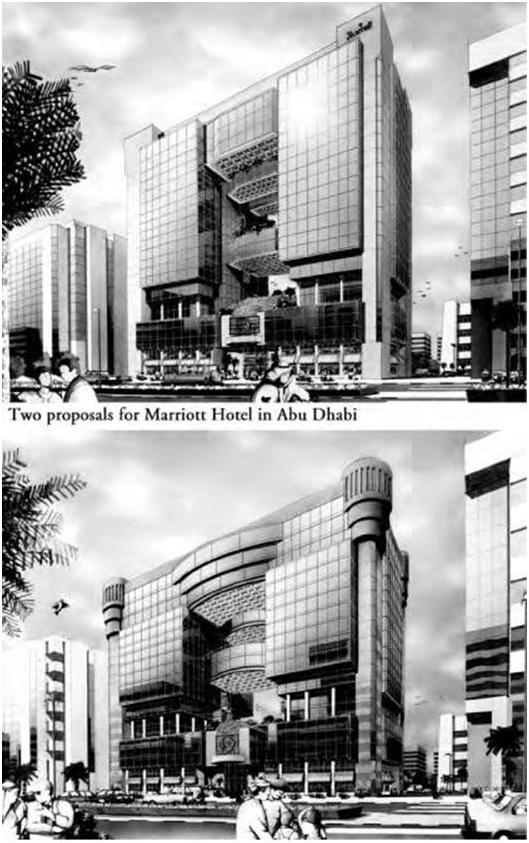 | |||
| Figure two.7A Presentations can play a pivotal function in convincing a client to approve a particular design. In this illustration, 2 design proposals past the author for a hotel, reflecting different architectural treatments, were submitted to both the customer and to Marriott for approval. | |||
| Blueprints and Construction Drawings: A Universal Language | 23 | ||
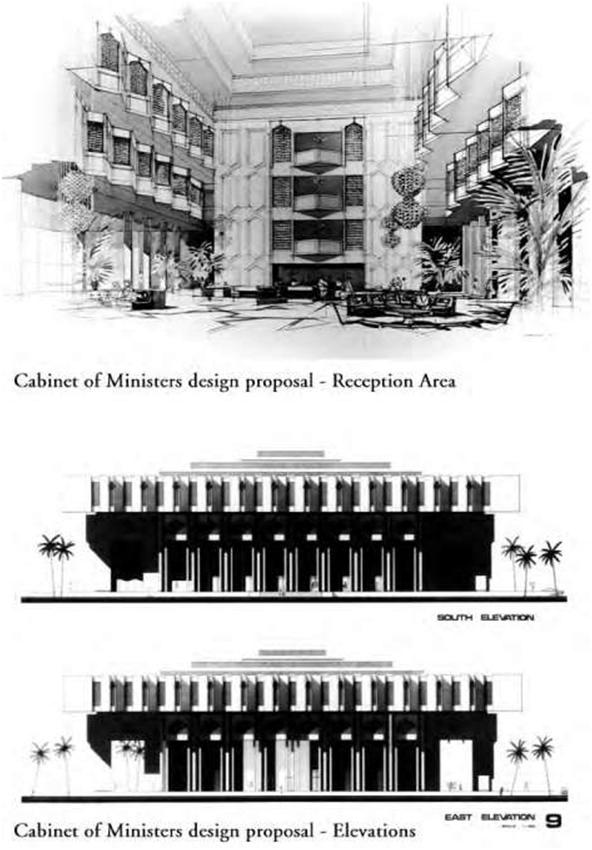 | |||
| Figure ii.7B International competition submission for a cabinet of ministers circuitous in Abu Dhabi past the author that won offset prize. | |||
| 24 | Affiliate two | ||
| Sometimes the press may exist difficult to read or important data may be missing from the drawings. Occasionally entire pages may be missing, or the contractor may have received only a gear up of plans or specifications. If the prints are incomplete or of poor quality, the consultant should be immediately notified and asked to address the trouble. Working drawings serve many functions: ane. They are the means for receiving a building permit. Before structure begins, the local building authority has to review the working drawings to ensure that they run across required building codes. A building permit will be issued after approving of the drawings. 2. They are used for competitive bidding. They permit contractors to study the documents and make bids based on their review of the drawings and other documents, thus providing the owner with the most economic cost for construction. 3. They provide instructions for structure. Working drawings should contain all the necessary information to build the construction. four. They are used for material take-offs. Labor, cloth, and other estimates are made from working drawings prior to commencement of construction. five. They provide a permanent record for future apply (such every bit remodeling and dispute resolution). half-dozen. They can exist used every bit a basis for leasing purposes. 7. Later the project is awarded, the drawings form the footing of the contract between the contractor, subcontractor, and client. The pages in a set of blueprints are ordinarily carefully lettered and numbered. The letters shown here are the ones about normally used in the manufacture: A: Architectural pages S: Structural pages P: Plumbing pages M: Mechanical pages E: Electrical pages Thus if a prepare of blueprints consist of 30 pages, it may exist numbered as follows: A1 through A8 (eight architectural pages); S1 through S10 (x structural pages); P1 through P3 (3 plumbing pages);M1 through M4 (4 mechanical pages); E1 through E5 (five electrical pages). Shop and Assembly Drawings Shop and assembly drawings are technical drawings prepared past various contractors, subcontractors, and suppliers participating in the construction process to show how their product is to be made. Since many products contain more one component, shop and assembly drawings (too called fabrication drawings) identify each component and testify how they all fit together. These drawings should contain all the necessary information on the size, shape, material, and provisions for connections and attachments for each member, including details, schedules, diagrams, and other related data to illustrate a cloth, product, or organization for some portion of the piece of work prepared past the construction contractor, subcontractor, manufacturer, distributor, or supplier. Product data includes items such equally brochures, illustrations, operation charts, and other information by which the work tin can be evaluated. The infor- | |||
| Blueprints and Construction Drawings: A Universal Language | 25 | ||
| mation provided must be in sufficient detail to permit ordering the cloth for the product concerned and its fabrication in the shop or m. In practise the consultant oft has to rely on these specialists to furnish precise information about their components. In most projects, whether big or minor, contractors and subcontractors are frequently required to typhoon shop drawings fifty-fifty for minor shop and field projects such as doors, cabinets, and the like. Thus, for instance, if complex cabinetwork is required, it must be built to exact size and specifications. A store drawing becomes necessary to ensure that the cabinetwork will fit into the construction and that the structure will accommodate it. In Figure 2.8A we encounter store-cartoon details for a restaurant waiter station and Figure 2.8B shows how a chiffonier is to be assembled. Approval of the shop drawings usually precedes the bodily fabrication of the component. Shop drawings also help the consultant check the quality of other components that subcontractors advise to furnish. Details Item drawings provide information about specific parts of the construction and are on a larger calibration than general drawings. They bear witness features that do not appear at all or are on likewise small a scale in general drawings. The wall section and lift details in Figures ii.9A and B are typical examples and are drawn to a considerably larger scale than the plans and elevations. Framing details at doors, windows, and cornices, which are the most mutual types of details, are most always shown in sections. Details are included whenever the data given in the plans, elevations, and wall sections is non sufficiently "detailed" to guide the craftsmen on the chore. Figure ii.10 shows some typical door and eave details. A particular contains both graphic and written information. An surface area of construction is drawn at a larger calibration in order to clearly show the materials, dimensions, method of building, desired articulation or attachment, and and then on. Details are often drawn as sections. It is as if a piece is made through a specific area and the inner components are visible. In Figures 2.11A and B we see an example of a typical bay window detail. There are many types of details, all of which are drawn as needed to analyze specific aspects of a design. A drawing canvas will often show several details. The complication of the project volition determine which areas need to be shown at a larger scale. Details are always drawn to calibration. A typical scale for a item is three inches to 1 human foot (scale: 3 inches = 1 foot, 0 inches). The scale for each detail will vary depending on how much information is required to make the structure clear to the builder. Each detail volition take the scale noted below. Specialized and Miscellaneous Drawing Types At that place are numerous other types of drawings used by architects and engineers in the construction industry. Freehand sketches are drawings made without the aid of any type of cartoon instruments. Sketches tin can exist an extremely valuable tool for architects, designers, builders, and contractors. Information technology is oftentimes the quickest and nigh economical method to communicate ideas (Figures 2.12A, B, and C), construction methods, and concepts or to record field instructions. Information technology is an platonic method to sell an idea to a client and get preliminary blessing for a blueprint. As well, when installing mechanical or electrical systems and circuits, you may sometimes have to exchange information about your task with others. A freehand sketch can be an accurate and appropriate method to communicate this data. This type of drawing is informal in character, may or may not be drawn to scale, and need not follow any detail format. A | |||
| 26 Affiliate two | ||
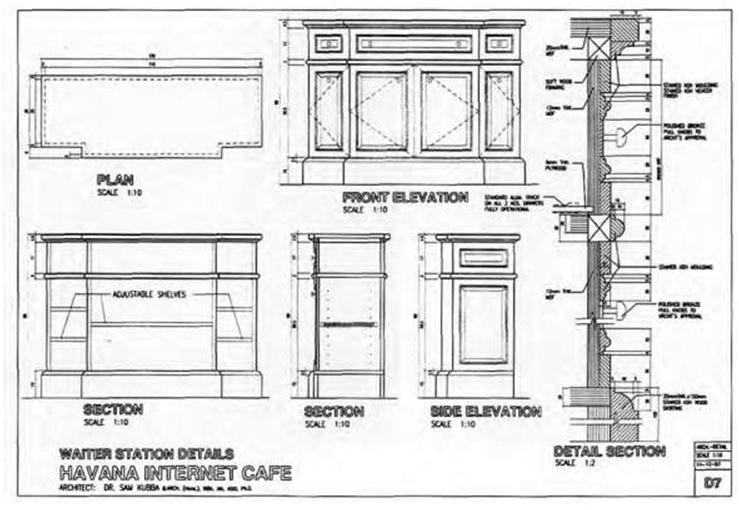 | ||
| Figure 2.8A Drawing showing the details for a restaurant waiter station. | ||
| sketch can be used in many ways. Another case of where to apply a sketch is to show a field alter that must be made. No matter how well a project is planned, field changes may sometimes need to be made, and a sketch will ofttimes get a long style to helping the builder visualize the designer'due south intention or the construction techniques to be used. Sketches may include dimensions, symbols, and other data needed to convey your idea of the required alter to someone else (such as the projection supervisor or project chief). Erection drawings, or erection diagrams, indicate the location and position of the various members in the finished construction. Erection drawings are especially useful to builders performing the erection in the field. The information erection drawings show includes supplying the approximate weight of heavy pieces, the number of pieces, and other helpful data. Framing drawings are necessary to evidence the layouts and provide other relevant data about the various framing components. These include floor joists, trusses, axle locations, and other structural elements. Framing layouts are drawn to calibration simply don't unremarkably get into the details of each stud location in the walls, because framing contractors are required to follow certain rules and regulations to assure that the construction meets the required building-lawmaking specifications. | ||
| Blueprints and Construction Drawings: A Universal Linguistic communication 27 | ||
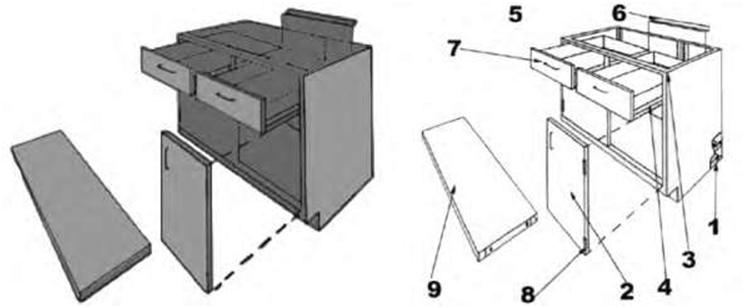 | ||
| Effigy two.8B Illustrations showing the components of a chiffonier. | ||
| Falsework drawings bear witness temporary supports of timber or steel that are required sometimes in the erection of hard or important structures. When falsework is required on an elaborate scale, drawings similar to the general and detail drawings already described may be provided to guide construction. For simple falsework field sketches may be all that is needed. Main-plan drawings are commonly used in the architectural, topographical, and construction fields. They show sufficient features to exist used every bit guides in long-range expanse evolution and usually contain a considerable amount of data including section purlieus lines, profile lines, acreage, existing utilities, rights-of-fashion and appurtenances, horizontal and vertical command information, locations and descriptions of existing and proposed structures, existing and proposed surfaced and unsurfaced roads and sidewalks, streams, and north-point indicator (pointer). 2.5 TITLE BLOCKS | ||
| It is standard practice to include a title block on each page of a set of blueprints. It is typically located in the bottom right-paw corner of the drawing frame. Many firms, nonetheless, are using customized sheets that extend the title block from the lower right to the upper right-mitt side of the sheet (Figure 2.13). The title block should bear witness the proper noun of the projection and the drawing and sheet numbers as well as the drawing title (e.g., "site plan"). The drawing number is especially important, both for purposes of filing the blueprint and for locating the correct drawing when it is specified on another blueprint. The title cake also typically shows the proper noun of the consultant, builder, engineer, or designer and the signature of the approving authorization. The title block should unremarkably show the date the drawing was made and the initials of who made it. This information is important because using an outdated set of drawings tin can crusade serious bug. Whatsoever revisions should exist noted within the title block. | ||
| 28 | Affiliate 2 | ||
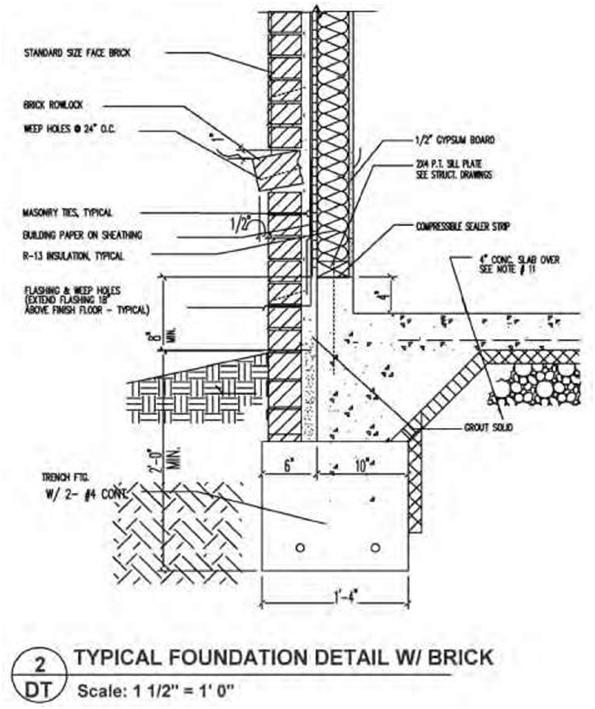 | |||
| Figure 2.9A AutoCAD cartoon showing a typical foundation/wall section detail for a new residence. | |||
| To summarize, the title block should generally contain the following information: Name of the consultant, visitor, or organisation with address and phone number. Title of the cartoon. This is an identification of the project by customer proper noun, company, or project name. Cartoon number. This can exist a specific job or file number for the drawing. | |||
| Blueprints and Construction Drawings: A Universal Linguistic communication | 29 | |||
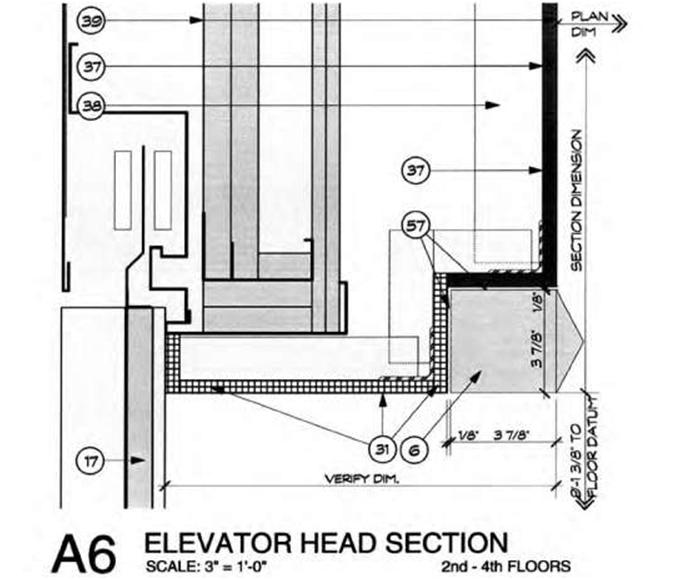 | ||||
| Effigy 2.9B Case of an elevator particular for a commercial building produced on VectorWorks/MiniCAD using a Macintosh computer (courtesy Herring and Trowbridge, Architects). | ||||
| • | Scale. Some consultant firms provide a location for the general scale of the drawing in the title block, although nearly firms now omit the scale from the title block and place it on the sheet direct below the championship of each individual plan, view, or detail. Where more than than one scale is used, as is found on detail sheets, the space for indication of scale should read "as noted" or "equally shown." The signature or initials of the drafter, checker, approval officeholder, and issuing officer, with the respective dates, should be shown. Drawing or sheet identification. Each canvass should exist numbered in relation to the entire set up of drawings. Thus, if the gear up consists of ten sheets, each consecutive sheet is numbered 1 of x, ii of ten, and then on. Other information equally required. | |||
| • | ||||
| • | ||||
| • | ||||
| 30 | Chapter 2 | |||
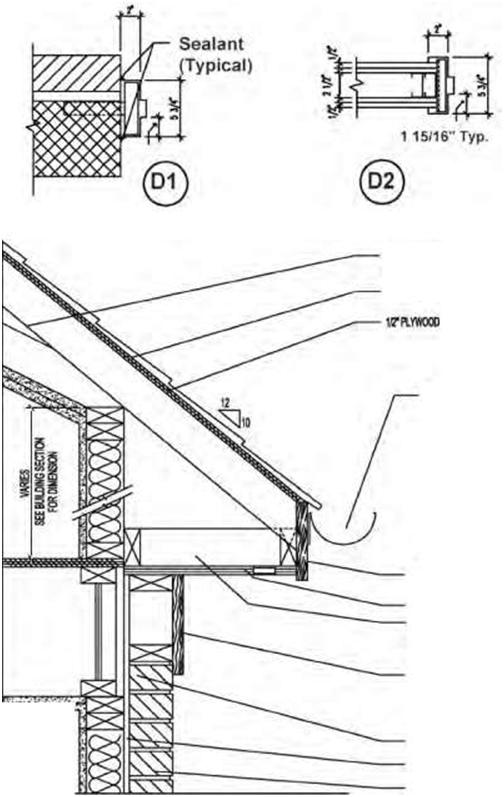 StttO FRIEZE BO. .'.■■■■..!-;;■'*.■■- | BOOfTRUSSES Encounter ROOFFRAMING PLAN SEE STRIP ELEV. FOR ROOF Textile | A | ||
| KALF Circular GUTTER (TYP.f | ||||
| Due west*8 FASCIA Board Iff PLYWOOD Westward<!" VENT (TYR) 2X1 BLOCKING | ||||
| Metallic FLASHING SHEATH NG BRKKFACAOEPYP.) | ||||
| EAVE DETAIL (WITH BRICK FACADE) Scale: 1 1/2″ = 1*0″ | B | |||
| Figure 2.ten Typical AutoCAD-generated door (A) and eave (B) details. | ||||
| Blueprints and Structure Drawings: A Universal Linguistic communication | 31 | ||
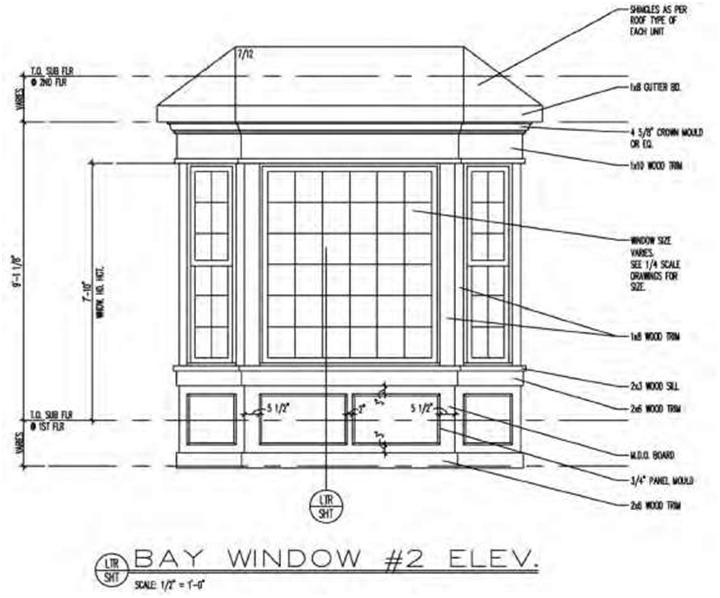 | |||
| Figure ii.11A An AutoCAD drawing of a residential bay window showing an pinnacle. | |||
| The following information is also ordinarily required in title blocks: the name and location of the action, the specifications and contract numbers (if whatsoever), the preparing activity including the architect-engineer (A-Due east) firm if applicable, and the surnames of the personnel concerned in the preparation of the drawings. Revision Block Many firms provide a revision column in which drawing changes are identified and recorded. The revision block is usually located in the correct-hand comer of the blueprint. All revisions are noted in this cake and dated and identified past a letter and an optional brief clarification of the revision with the initials of the individual making the change (Figure 2.14). If changes are made on the face of the drawing after it has been released for construction, a circle with a revision number or alphabetic character should accompany the modify. | |||
| 32 | Chapter 2 | ||
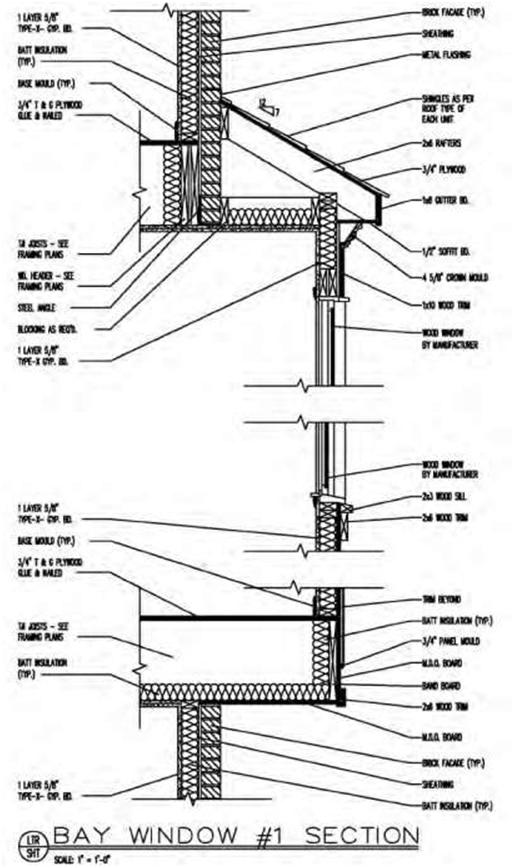 | |||
| Figure 2.11B An AutoCAD drawing of a residential bay window showing item. The information shown on the detail allows the builder to construct the bay window as intended. | |||
| Blueprints and Structure Drawings: A Universal Language | 33 | ||
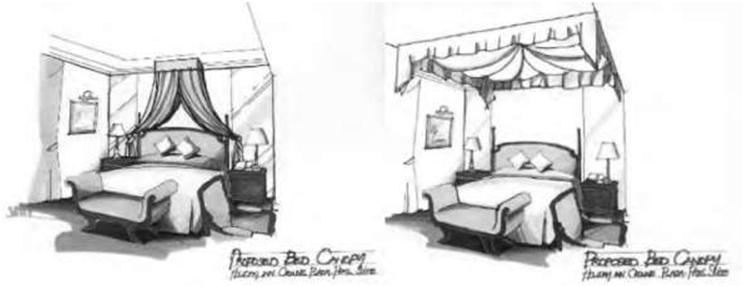 | |||
| Effigy 2.12A Sketch of a president's suite bedchamber—Crowne Plaza, Abu Dhabi. | |||
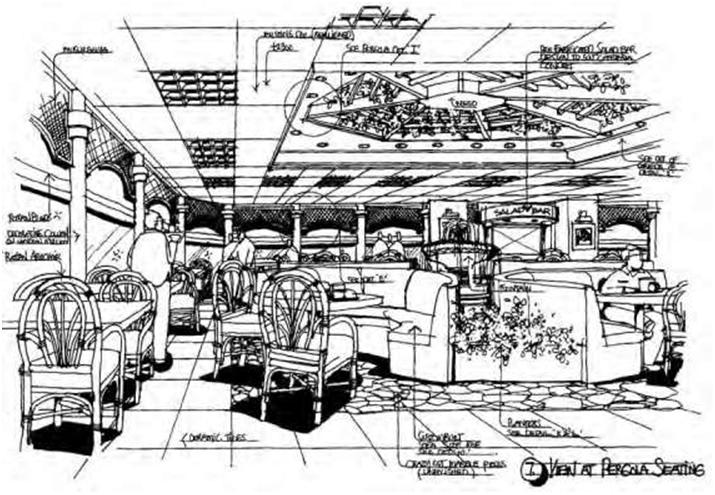 | |||
| Figure 2.12B Sketch of Havana Internet Buffet, Abu Dhabi. | |||
| 34 | Affiliate 2 | ||
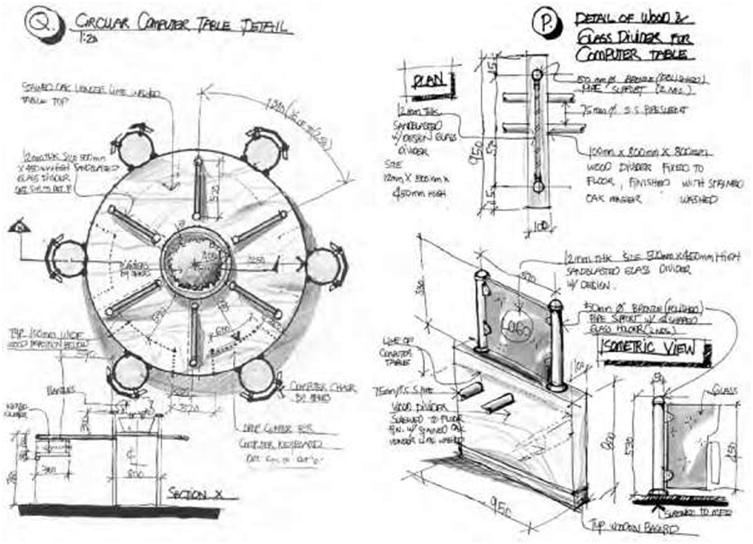 | |||
| Figure 2.12C Sketch of reckoner desk details, Havana Internet Cafe, Abu Dhabi. | |||
| Scale The graphic representation of the project is drawn to some proportion of the actual size of the projection; ordinarily 1/8 inch is equal to a foot. Although the original cartoon may be scaled accurately, the print will exist a copy of that original and is not likely to exist the same size equally the original drawing. The copy may have been reduced slightly. Likewise, the paper size is ofttimes afflicted by temperature and humidity and may therefore stretch or compress. Due to these and other factors, avoid relying on measurements taken past laying a rule on the drawing. | |||
| Zoning For large projects, a drawing may sometimes exist divided into a filigree using letters and numbers. When zoning is used, it is typically located within the drawing frame. Zoning allows easy reference to various parts of the cartoon by referencing a coordinate such equally B4. | |||
| Blueprints and Construction Drawings: A Universal Language | 35 | ||
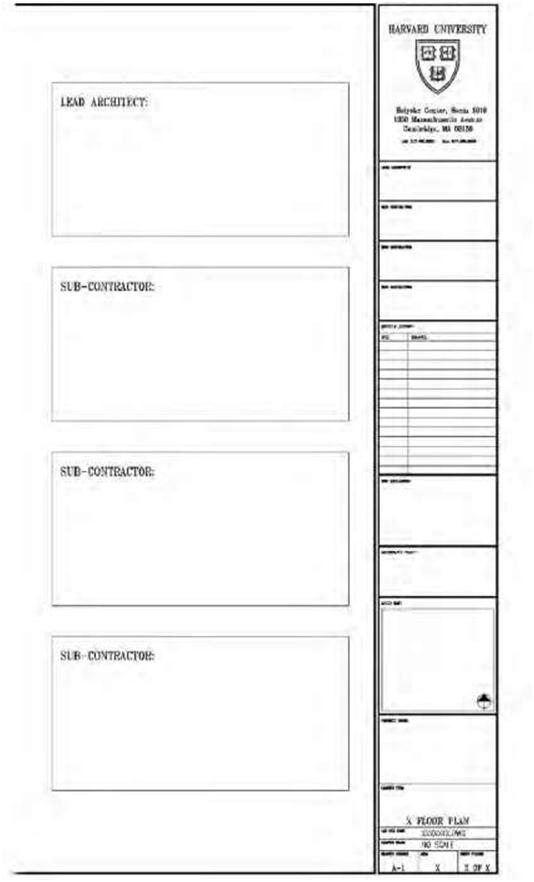 | |||
| Figure 2.13 Cover sheet including title block used by Harvard University on its working cartoon documents. | |||
| 36 | Chapter ii | ||
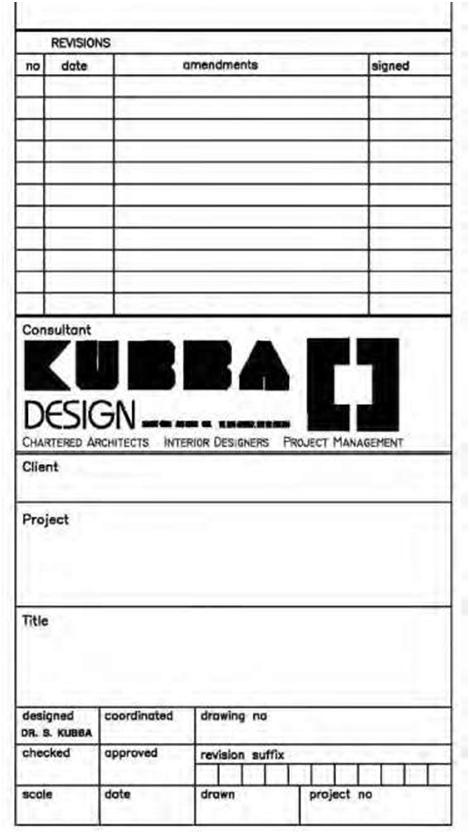 | |||
| Figure 2.14 Title block showing position of revision block on a consultant'southward typical working drawings. | |||
| 3 | |||
| Understanding Line Types | |||
| 3.1 INTRODUCTION—THE ALPHABET OF LINES | |||
| The alphabet of lines is the universal linguistic communication of the technician, architect, and engineer. In reality, lines are the ground of all construction drawings. To read and empathise blueprints, you need to understand the use of lines. By combining lines of different thicknesses, types, and lengths, it is possible to graphically describe objects in sufficient detail to allow a person with a basic understanding of blueprint reading to accurately visualize their size and shape. As will be explained, line characteristics such equally width, breaks, and zigzags all accept significant, and each line has a specific design and thickness that distinguishes it from other lines. Drafting is an international graphic linguistic communication that uses lines, symbols, and notes to describe a structure to be built, and lines themselves are expressive tools on well-executed drawings. Certain lines are drawn thick and then they stand up out conspicuously from other information on the cartoon, whereas other lines are fatigued thin. Thin lines are not necessarily less important than thick lines, only they are subordinate for identification purposes. Drawings with simply lines of the same intensity are oft difficult to translate and usually monotonous to read. Equally mentioned in Chapter ane, in that location are a number of organizations such as the American National Standards Institute (ANSI) and the International Organization for Standardization (ISO) that accept voluntarily adopted certain drafting standards that are generally accustomed and widely used around the world. 3.2 LINE WEIGHTS AND TYPES | |||
| Line weights are generally subject to the post-obit conventions: 1. For transmission pencil drafting using drawing boards, finished work includes assuming object lines (2H to B pencils), light dimension lines, center lines, section lines, then on (3H to 5H pencils). Temporary construction lines, guidelines for lettering, and other types should be kept very low-cal (7H or 8H). Border lines for the drawing sheet and title block should be made bold (3B to 6B). ii. For inked or computer-plotted drawings unlike pen widths are used to achieve like effects (see Effigy 3.1). When plotting (printing) using a laser or inkjet printer from a computer drawing in | |||
| Copyright © 2009 by The McGraw-Loma Companies, Inc. Click here for terms of employ. | 37 | ||
| 38 | Chapter three | ||
| AutoCAD, these line-disrespect conventions are replicated by configuring each line color equally certain line widths. 3. Border lines are roughly twice every bit bold as object lines, which in turn are roughly twice every bit bold as dimension lines. In improver, AutoCAD drafting uses colors to emulate each thickness (black or white for objects, greenish for dimensions, blue for borders, etc.). In AutoCAD'due south print-dialogue box you are allowed to designate unlike line widths for each different colour. Line Types: The major line types and line thicknesses using pens or plotter machines are outlined below. Information technology becomes obvious from the table below that larger sheets require the use of thicker lines than smaller sheets. Object Lines Object lines, also known every bit visible lines, are solid lines used mainly to define the shape and size of a structure or object. They are continuous prominent lines representing the edges of surfaces or the intersection of two surfaces, equally shown in Effigy 3.2. An object/visible line is typically fatigued thick (dark) and solid so that the outline or shape of the object (e.thou., wall, floor, acme, detail, or section) conspicuously stands out on the drawing with a definite contrast betwixt these lines and secondary lines on the drawing. They are heavier than subconscious lines, dimension lines, center lines, and broken lines. As nosotros shall see later in the chapter, design drawings oft contain different solid line types that are not object lines. Dashed Lines Dashed or hidden lines serve more than one purpose in structure drawings. They are comprised of medium- or light-weight, uniformly sized broken lines consisting of evenly spaced short dashes and are generally intended to represent hidden surfaces or intersections of an object. On floor plans they may be used to represent features that lie in a higher place the plane of the cartoon, such every bit high wall cabinets in a kitchen. You may vary the lengths of the dashes slightly in relation to the size of the drawing. On remodeling-chore drawings, they are also used to signal the position of preexisting construction. In some cases they are used for relationship clarification or to show culling positions of a movable component. To be consummate, a drawing must include lines that stand for all the edges and intersections of the surfaces in the object. Many of these lines are invisible to the observer because they are covered past other portions of the object. For example, in Figure iii.3A the dashed lines point the location of blocking subconscious behind the wall. In architectural drafting dashed lines may be practical in different weights to reflect their purpose (e.k., to reverberate importance or altitude from the master view) while showing drawing features that are not visible in relationship to the view or plan. These dashed features can be subordinated to the master emphasis of the cartoon. Subconscious lines should typically begin and end with a nuance, in contrast with the visible lines from which they start, except when a dash would form a continuation of a visible line. Dashes should be joined at comers; likewise, arcs should begin with dashes at tangent points. Hidden lines should be omitted when non required for the clarity of the drawing. Although features located behind transparent materials may be visible, they should exist treated preferably every bit curtained features and shown with hidden lines. Examples of dashed-line representations include beams and headers, upper kitchen cabinets, un-dercounter appliances (e.g., dishwasher or refrigerator), or electric circuit runs, as shown in Figure three.3B. Figure 3.3C is some other instance of hidden-line employ. | |||
| Understanding Line Types | 39 | ||
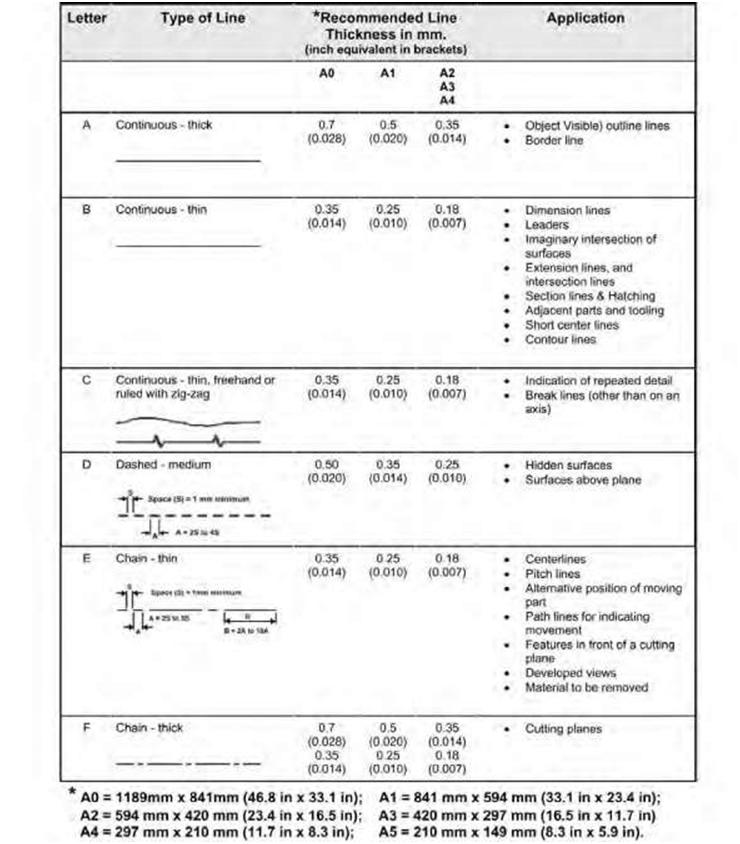 | |||
| Effigy 3.ane Major types of line used in structure drawings. Line weights are clearly impacted by canvas size. The larger the canvas beingness used, the heavier the line weight required. An object line on an AO canvass for example should be twice as thick equally an object line drawn on an A2, A3, or A4 sheet. | |||
| 40 | Chapter 3 | ||
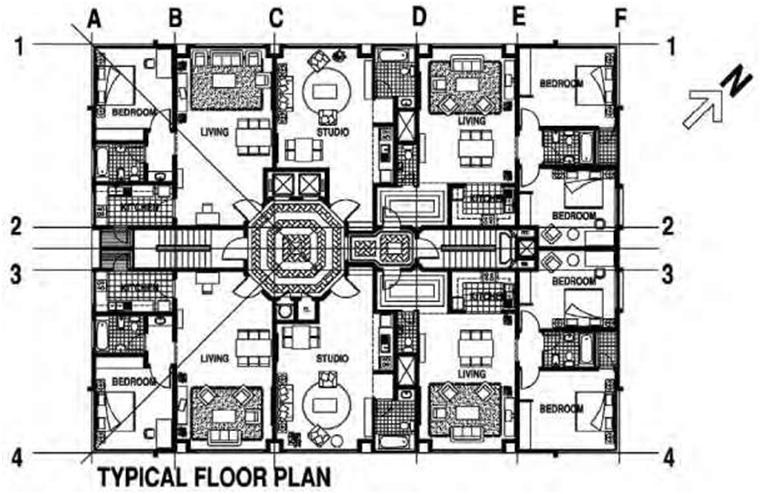 | |||
| Figure 3.two Object lines identify and describe the shape of an object. For example, in this drawing object lines are used to portray the article of furniture equally well as the various architectural elements in the blueprint (e.g., stairs, elevators, walls, etc). | |||
| Section Lines Section lines (likewise called cross-hatch lines) indicate the cut surface in a section view. They ordinarily consist of fine linework (thinner than object lines), typically angular (45 degrees), giving a tone to sectioned surfaces (Figures 3.4A and B. Section lines are used to emphasize the cutting-plane surface and make the view easier to visualize. | |||
| Center Lines Center lines consist of thin (light), broken lines of alternating long and short dashes. They are used to identify the centers of symmetrical objects such as a column, wall, or window. Center lines are besides used to point the center of a whole circle or part of a circle and to testify that an object is symmetrical most a line (Figures 3.5A and B). The symbol is typically drawn as such: (C/L). Heart lines are symmetrical on the centrality of circular features and are likewise used to locate centers of windows and door symbols on floor plans. | |||
| Understanding Line Types | 41 | ||
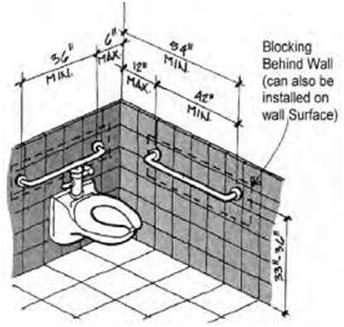 | 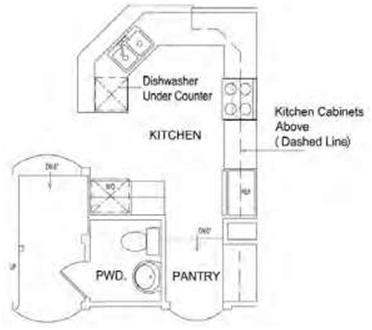 | ||
| Figure three.3A Hidden lines represent invisible edges and surfaces—in this case, blocking hidden behind a wall. | Figure 3.3B Subconscious lines hither represent an undercounter appliance and hung kitchen wall cabinets. | ||
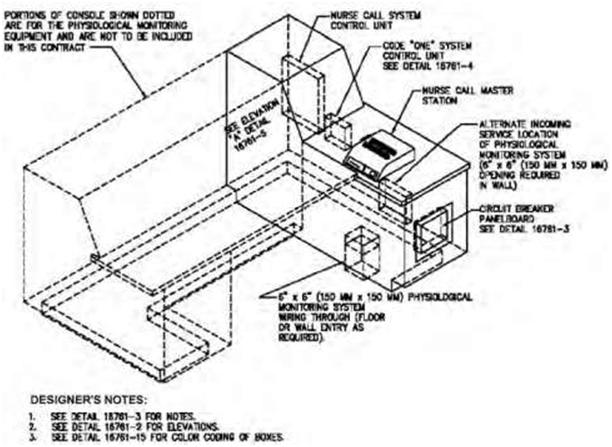 | |||
| Effigy iii.3C An illustration of a nurses' console showing extensive employ of subconscious lines. | |||
| 42 | Affiliate 3 | ||
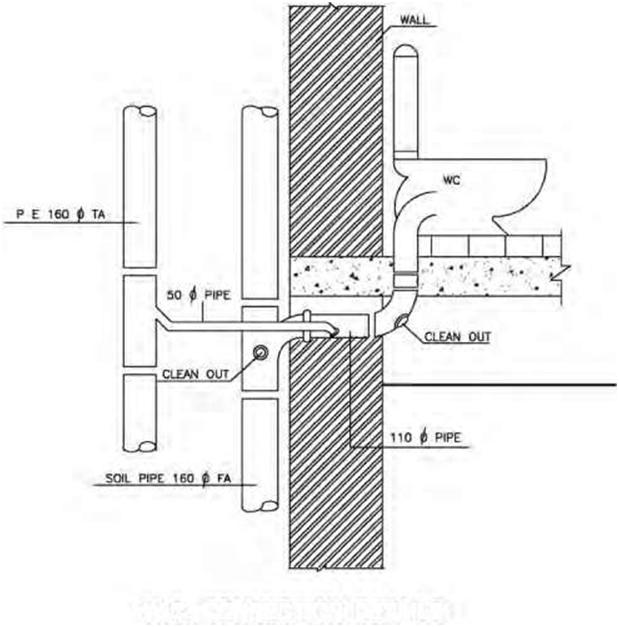 | |||
| Westward.C. Connection DETAILS Figure three.4A Sectional lines add accent to the walls in this analogy. | |||
| The long dashes of center lines may vary in length, depending upon the size of the drawing. Center lines should begin and stop with long dashes, and they should non intersect at the spaces between the dashes. They should extend uniformly and distinctly a short distance beyond the object or feature of the drawing unless a longer extension line is required for dimensioning or for some other purpose. Very short eye lines may exist unbroken if there is no confusion with other lines. Symmetry lines are center lines used as axes of symmetry for partial views. To identify the line of symmetry, two thick, short parallel lines are fatigued at right angles to the center line. Symmetry lines are | |||
| Understanding Line Types | 43 | ||
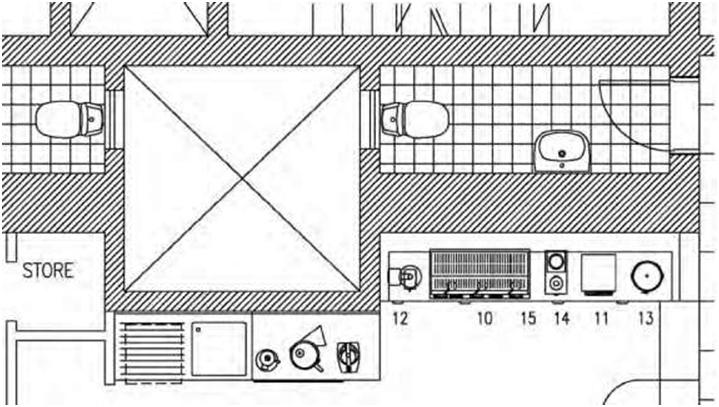 | |||
| Figure 3.4B Sectional lines add emphasis to the walls in this illustration. | |||
| used to represent partially drawn views and partial sections of symmetrical parts. Symmetrical-view visible and hidden lines may exist extended past the symmetrical line if this improves clarity. | |||
| Extension Lines Extension lines are used in dimensioning to show the size of an object. Extension lines are thin, dark, solid lines that extend from an object at the exact locations between which dimensions are to be placed. A space of approximately ane/16 inch is usually allowed between the object and the beginning of the extension line (Figure 3.6). Plan to avoid crossing other extension lines and/or dimension lines. Extension lines are fine lines that relate the dimension lines to their features. They do not touch the features; instead they beginning about 1/6 inch (four.23 mm) from the feature and extend about 1/8 inch (three.175 mm) beyond the arrowheads of the dimension line. Extension lines evidence the extent of a dimension, and dimension lines show the length of the dimension and terminate at the related extension lines with slashes, arrowheads, or dots. The dimension number in feet and inches is placed above and nigh the heart of the solid dimension line. | |||
| 44 | Chapter 3 | ||
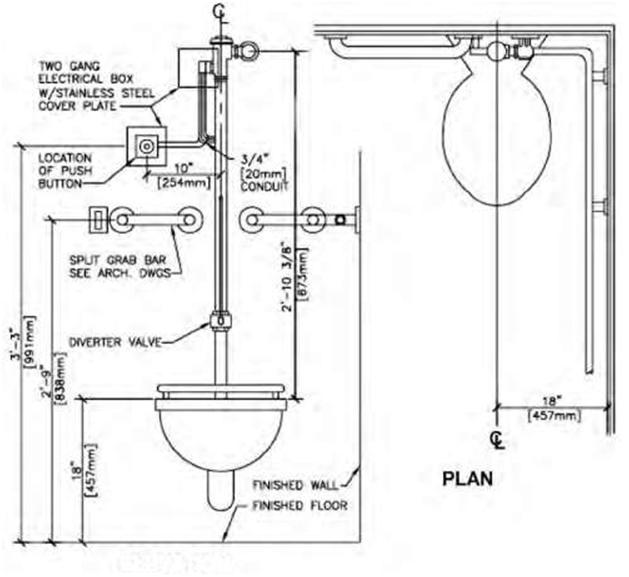 | |||
| Superlative Figure 3.5A Center lines indicate the centers of circles, arcs, and symmetrical objects. | |||
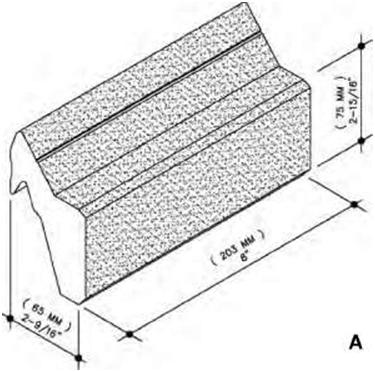
| Dimension Lines Dimension lines are solid lines like in weight to extension lines that are used to indicate length. They are drawn from one extension to the next, representing the distance betwixt the extension lines. One time the external shape and internal features of a part are represented by a combination of lines, farther information is provided by dimensions. Fractional, decimal, and metric dimensions are used on drawings to give size descriptions. Each of these iii systems of dimensioning is used throughout the text. Dimension lines are fine lines that are often broken at the dimension and catastrophe with arrowheads, dots, or a small diagonal line (Figures 3.6, 3.7A and B). The tips or points of these arrowheads bespeak the exact distance, referred to by a numerical dimension placed either at a interruption in the line or directly above the lines most their middle. | |||
| Understanding Line Types | 45 | ||
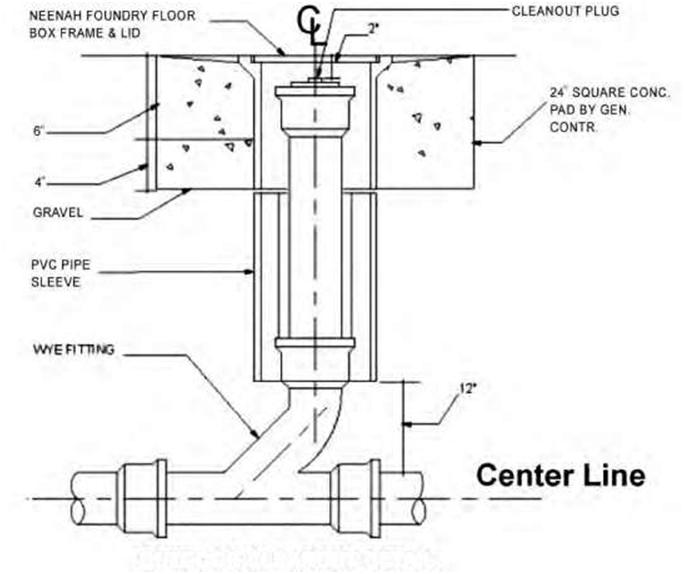 | |||
| OUTDOOR CLEANOUT Detail Figure 3.5B Center lines point the centers of circles, arcs, and symmetrical objects. | |||
| Different types of arrowheads are used in dimensioning. The bespeak or tip of the arrowhead touches the extension line. The size of the arrow is adamant by the thickness of the dimension line and the size of the drawing. Closed and open up arrowheads are the two shapes generally used. The closed arrowhead is preferred. The extension line usually projects 1/16 inch beyond a dimension line. Any boosted length to the extension line is of no value in dimensioning. When dimensions can be added together to come with one overall dimension, they are known as concatenation dimensions. Concatenation dimensions are usually expressed in a single line whenever possible (Effigy 3.7B). | |||
| 46 | ||
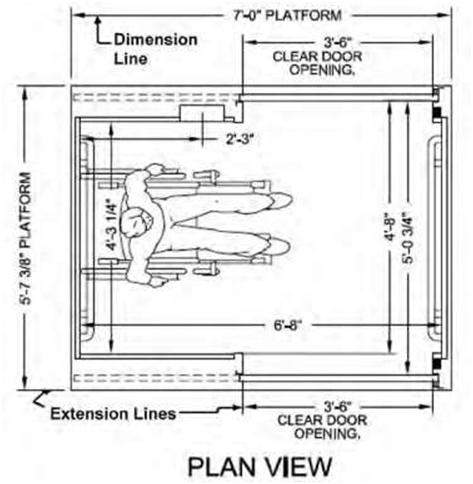 | ||
| Figure three.six Extension lines are typically used for dimensioning. | ||
| Phantom Lines Phantom lines are thin, dark lines that consist of a long dash and ii short dashes. They look like cut-airplane lines except that they are lighter. Phantom lines are used mainly to show alternative positions of fixtures, movable partitions, move (e.g., culling door swings) or future construction additions (as well as existing structures to be removed). They are likewise used to bespeak repeated details and materials prior to machining. Leader Lines and Arrowheads Leader lines are fine lines terminating with an arrowhead or dot at ane stop to chronicle a notation or callout to its characteristic. They are ofttimes fatigued at an bending or straight from the principal lines on the drawing or in a gratis-curved manner to distinguish them easily from object lines. Leader lines are used to label elements by connecting an object to a note or abbreviation or a dimension to the object information technology represents on a drawing (Figures 3.8A, B, and C). | ||
| Understanding Line Types | 47 | ||||||
 | |||||||
 | ^=^m |  | |||||
 | thirteen+0 | ||||||
| 42 tO | . 1550 ,960 , 1530 tP—————*-^——iF—————*- | 6950 | |||||
| 17630 | |||||||
| CROWN PLAZA RESIDENCE | B | ||||||
| Figure 3.7 A. Dimensions terminated with dots. B. Example of a concatenation-dimensions line. | |||||||
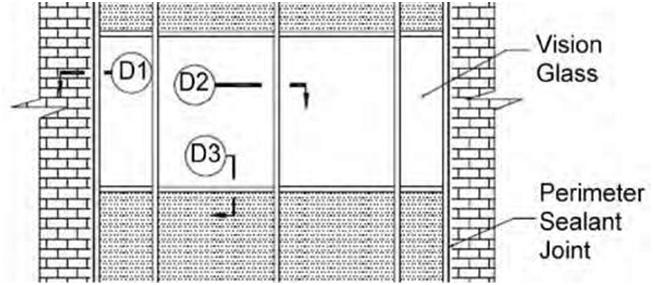
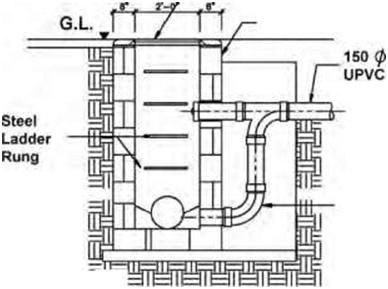
| Cutting-Plane and Viewing-Airplane Lines These are very prominent broken lines (usually two dots and a dash) that are used to show the location of cutting planes for sectional views. Arrows on their ends indicate the direction in which the department is observed (Figure 3.9A). Lines or circular symbols are sometimes used at their ends to relate the cutting planes to their section views. Like property lines, these lines are commonly heavier than any other lines on a cartoon. | |||||||
| 48 | Chapter 3 | |||
 | A | |||
 | B | |||
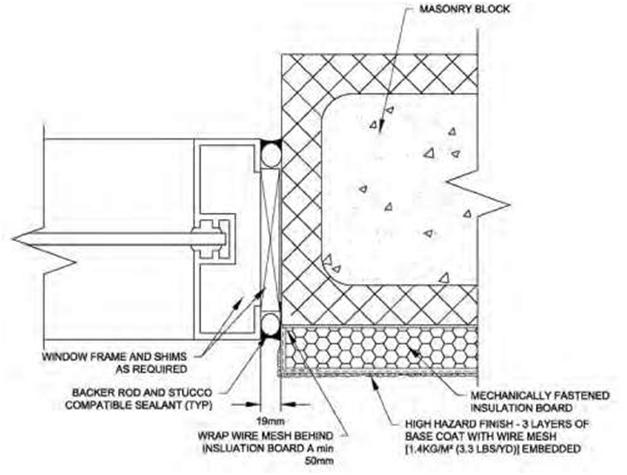
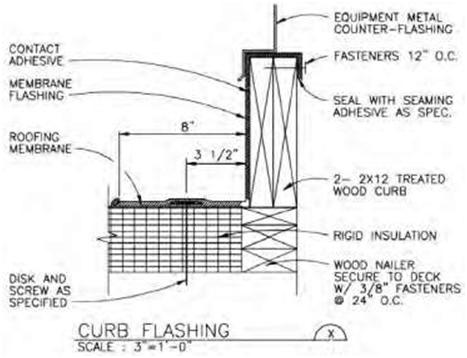
| xlx Effigy 3.8A,B Examples of leader lines terminating with arrowheads. | ||||
| Understanding Line Types | 49 | ||
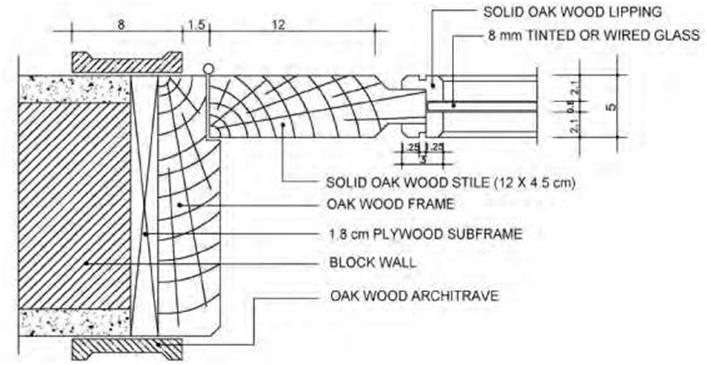 | |||
| Figure 3.8C Example of a leader line terminating with a dot. | |||
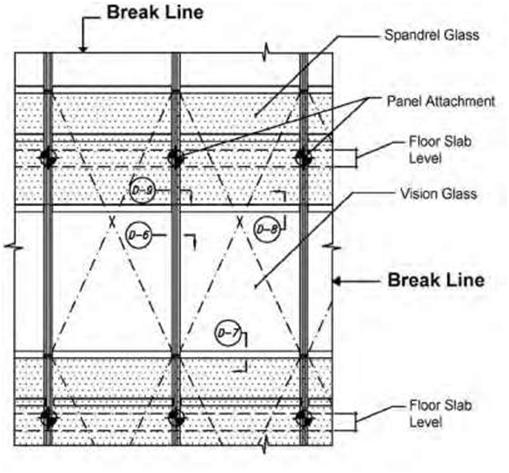
| Break Lines These are fine straight lines with zig-zag-zig offsets to show a pause or termination of a fractional view or to omit portions of an object. Architects frequently employ interruption lines to eliminate unimportant portions of details, thus allowing the of import portions to exist made larger. They are also used on detail and assembly drawings. Small break lines are oft fine, ragged lines. A directly, sparse line fabricated with freehand zigzags is used for long breaks, a thick freehand line for brusk breaks, and a jagged line for wood parts. Special breaks may exist used to show cylindrical and tubular parts and to indicate that an end view is not shown; otherwise, the thick break line is typically used. The type of break line normally associated with architectural drafting is the long break line. Break lines are used to terminate features on a drawing when the extent of the feature has been clearly divers. Contour Lines These are fine lines that are used mainly to delineate variations in a site's elevation. If a site is adequately level, at that place volition be few if any contour lines on the drawing, whereas if it has a pregnant slope, information technology is likely that the plot plan will show a number of profile lines. Sometimes a model is used to depict the topography of a site (Figure iii.11). Holding Lines Property lines define the boundaries of a property. These lines are usually heavier than other lines on site or plot plans. | |||
| 50 | Affiliate 3 | |||||
| rh | Encompass equally per schedule Refer to Structural Drwg, | |||||
| Incoming | ||||||
| -he: | -.-.^Pl | ^B-fifty | ||||
| UPVC Backdrop | ||||||
| kM y-°- United nations | ||||||
| Program | iihh section a-a Properties and manhole particular | A | ||||
 | B | |||||
| Figure 3.9A,B Examples of cutting-plane lines. | ||||||
| Understanding Line Types | 51 | ||||
 | A | ||||
| Bent Plate 1/4 in x iv in x 4 in x 6 in (6mm x 100mm x 100mm x 150mm) | |||||
| Break Lines | 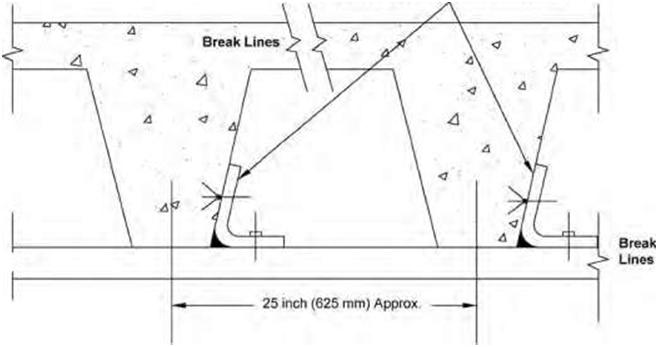 Break Lines | B | |||
| Suspension | |||||
| Lines <> | |||||
| Figure three.10A,B Examples of the use of break lines. | |||||
| 52 | Chapter iii | ||
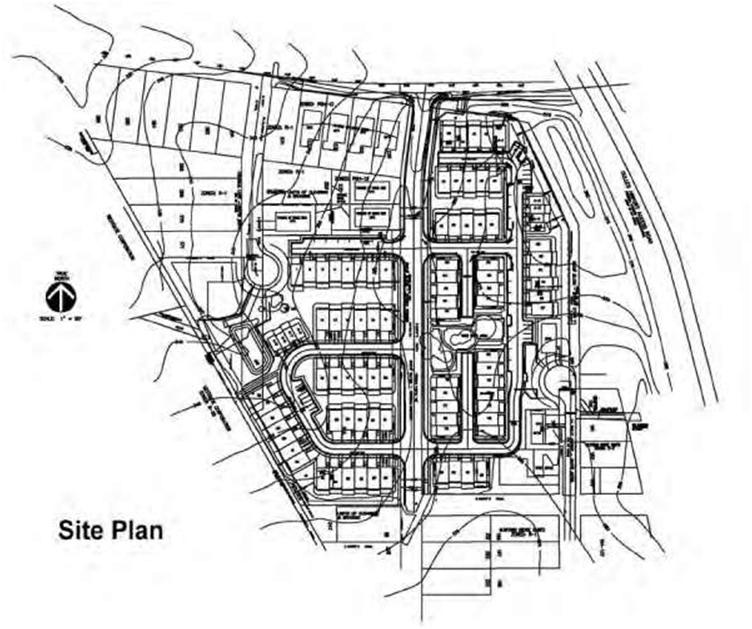 | |||
| Figure 3.eleven Illustration of a model showing the topography of the site. | |||
Source: https://www.construction53.com/2011/08/blueprints-and-construction-drawings-a-universal-language/
0 Response to "Is It Standard to Include Plumdomain7 Plans in Architectural Drawings"
Enviar um comentário